

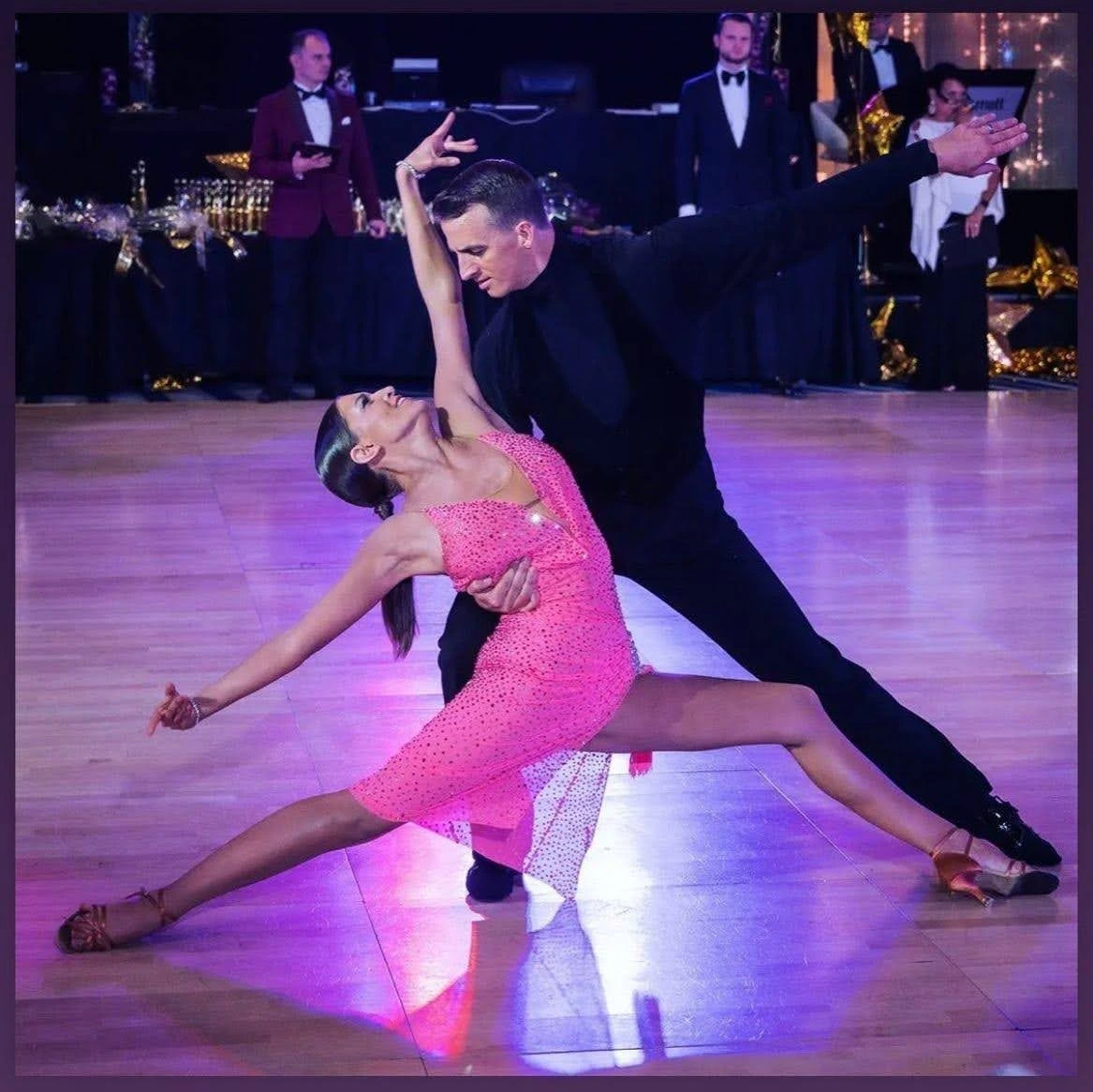
International Latin ballroom dance is a competitive partner-dance category featuring Cha Cha, Samba, Rumba, Paso Doble, and Jive. Each has its own rhythm, movement, and character. Learning the differences helps you recognize what you’re watching and decide what you’d like to try.
At a competition, the same couple might dance a slow, sensual Rumba and, just minutes later, a fast, bouncy Jive. Both belong to International Latin, but each one calls for different skills, from controlled balance to quick, sharp footwork.
What Is International Latin Ballroom Dance?
International Style is a standardized system of ballroom dancing used in competitions around the world. It’s divided into two categories: International Standard and International Latin. Each dance has set rules for how you use your feet, transfer your weight and connect with your partner, so dancers everywhere learn and are judged by the same standards. International Standard covers the smooth, traveling dances: the Waltz, Tango, Viennese Waltz, Slow Foxtrot and Quickstep.
International Latin, by contrast, focuses on rhythm, hip action and sharp footwork, with dancers often moving in place or in open positions rather than traveling around the floor.
How Does Latin DanceSport Differ From Social Latin Dancing?
Latin DanceSport refers to competitive dancing, while social Latin dancing centers on dancing with others for enjoyment. In International Latin events, the program draws from the five dances listed above. Salsa and Bachata sit outside that program, although both have their own competitions.
These labels describe the setting and style, not how seriously someone learns. Social dancers still work on timing and technique. You can also learn International Latin ballroom dance simply because you enjoy its music and movement.
Partner connection changes throughout a routine. Dancers may use a closed hold, connect through one or both hands, or separate. Latin doesn’t mean constant hip motion: Rumba’s controlled action looks quite different from Paso Doble’s strong posture.
How Is International Latin Different From American Rhythm?
International Latin and American Rhythm are two separate programs. They share some dance names, but they have different dance lists, techniques and goals. American Rhythm includes the Cha Cha, Rumba, East Coast Swing, Bolero and Mambo, so only the Cha Cha and Rumba appear in both.
The biggest differences:
- Where they come from: International Latin was standardized in England and is danced in competitions worldwide. American Rhythm developed in the United States, where it’s taught for both social dancing and competition.
- Technique: In International Latin, dancers usually take weight onto a straightened leg, which creates sharp, defined lines. In American Rhythm, the knee often bends as you step and then straightens, which gives the movement a softer, more relaxed look.
- Timing: even dances with the same name can start on different beats. Ballroom Rumba is the clearest example. An American beginner lesson usually introduces a box step on a slow-quick-quick count, while International Rumba steps on beats 2, 3 and 4 and continues the body action through beat 1.
- Where you’ll use it: American Rhythm dances like East Coast Swing and Mambo are easy to take to weddings and social events. International Latin is built more around the competitive floor.
Which one should you learn? If you mainly want to dance socially in the US, American Rhythm is often the natural first step. If you’re drawn to the look of International Latin, or want to compete in it someday, tell your instructor from the start. Many dancers end up learning both, since the skills in one make the other easier.
What Are the 5 Competitive Latin Dances?
The five dances are Cha Cha, Samba, Rumba, Paso Doble, and Jive. As the World Dance Organisation’s rules show, Latin is judged as its own program, separate from Ballroom (Standard).
Here’s how they compare, and which skill to focus on first as a beginner:
| Dance | Recognizable Movement | Beginner Learning Focus |
|---|---|---|
| Cha Cha | Crisp steps and a quick triple action | Keeping the 4-and-1 count clear |
| Samba | Rhythmic bounce and traveling patterns | Coordinating feet, knees, and body |
| Rumba | Slow weight changes and controlled hip action | Staying balanced through each step |
| Paso Doble | Marching movement and strong shapes | Posture and clear changes of direction |
| Jive | Quick chassés, kicks, and flicks | Small steps and steady timing |
Cha Cha
Cha Cha combines clear weight changes with a quick three-step action. In a basic side chassé, you step sideways, close the other foot, then step sideways again. A chassé is a sequence in which one foot chasses the other.
The familiar “cha-cha-cha” falls on 4-and-1, following steps on beats 2 and 3. The World Dance Foundation notes this timing in its guide to International Cha Cha. Saying the full count aloud helps you hear where the quick steps fit.
For a first practice, keep the side steps short enough to finish on time. If you stretch them too far, the quick middle step becomes hard to place. Work on clear weight changes before adding turns or arm styling.
Samba
Ballroom Samba combines traveling patterns with a rhythmic body action called Samba bounce. That action involves coordinated flexing and straightening through the knees and ankles. It adds a pulse to the movement rather than a series of jumps.
This partner style differs from the solo Samba forms associated with Brazilian Carnival. You’ll see couples move across the floor while changing their position relative to each other.
One beginner challenge is coordinating the bounce with the feet. Start with the pattern your instructor gives you, then add the body action gradually. Trying to create a large bounce before you know where your weight belongs can make the steps harder to control.
Rumba
International Rumba emphasizes controlled weight changes, sustained movement, and communication between partners. Its slower pace gives you time to notice the movement between steps. That also makes balance and timing especially clear.
In the basic rhythm, step on 2, 3, and 4, then continue the action through 1. Keeping your feet still for that beat doesn’t mean freezing your body.
Hip action develops through coordinated use of the feet, legs, and weight transfer. Don’t try to copy a dramatic hip movement while leaving your weight between your feet. First, learn to finish each transfer with balance and control.
Paso Doble
Built on a strong, marching rhythm, this dance draws its style from the drama of the Spanish bullfight. Its name means “double step” in Spanish. The leader often takes on the role of the matador, while the follower may represent the cape, but both partners play an active part in creating the dance’s bold, theatrical character.
Much of that drama comes from the music. Paso Doble songs have clear musical highlights, powerful moments where the music builds to a peak. Dancers mark them with a striking movement or a held shape. Learning to hear those moments is just as important as learning the steps, since it’s what makes the dance come alive.
As a beginner, start with upright posture and clear changes of direction. Large arm shapes may look impressive, but they won’t help if they pull you off balance. Your instructor can guide you on how much styling to add as your technique develops.
Jive
Fast, playful and full of energy, this dance grew out of American swing and jitterbug, which spread to Europe during World War II and were later refined into the ballroom version danced today. It’s built around two key elements: the rock step, where you transfer your weight back onto one foot and then return to the other, and quick chassés, each made up of three small steps.
The basic pattern takes six counts: 1, 2 for the rock step, then 3-a-4 and 5-a-6 for two chassés. Kicks and flicks add plenty of character, but they come later, once the basic timing feels natural.
Keep your steps compact and avoid leaning backward during the rock step. If your feet spread too far apart, it takes longer to bring them back under you, and you’ll quickly fall behind the music.
How Can Beginners Start Learning International Latin?
Most beginners start with one dance and build a strong foundation before moving on. Here’s what your first lessons will focus on at our dance studio in West Palm Beach, FL:
- One basic pattern: a short, repeatable step that you can dance comfortably to music.
- Timing: learning to hear the beat and step on the right count, like the 4-and-1 in Cha Cha or the 2-3-4 in Rumba.
- Weight transfers: moving fully from one foot to the other with balance, which is the foundation of Latin hip action.
- Posture: standing tall with your weight slightly forward, so you’re ready to move in any direction.
At Fred Astaire Dance Studios – West Palm Beach, you’ll start with private lessons, where your instructor can watch your timing and balance closely and correct small habits early. Then you can practice what you’ve learned in group classes and practice parties. Our teaching methods explain how these formats work together.
Choose a First Dance With Your Instructor
Most beginners start with either Cha Cha or Rumba, since both teach the basics you’ll use in every Latin dance. The right choice depends on the music you enjoy and how you like to learn. Cha Cha is upbeat and playful, with a quick chassé on 4-and-1, so it’s a great fit if you love energetic music and a clear, catchy rhythm. Rumba is slower and more romantic, with more time between steps, which suits you if you’d like to focus on balance, smooth weight changes and connection with your partner.
Whichever you choose, you’ll build the same foundation of timing, posture and controlled weight transfers, and that makes learning the other dances much easier later on.
And if Latin DanceSport interests you, say so from the start. Your instructor can explain which style and level your lessons will focus on, and plan your next steps at a pace that suits you, so you’ll know when you’re ready for your first event.
Ask About Your First Latin Lesson in West Palm Beach, FL
Whether a Rumba caught your eye or the energy of a Jive got your feet tapping, our instructors at Fred Astaire Dance Studios – West Palm Beach will help you find the right starting point for International Latin ballroom dance. You’ll begin with private lessons planned around your pace and goals, and you don’t need a partner to get started.
Call us at 561-478-1400 or fill out our introductory offer form to book your first lesson. You’ll find us at 1804 North Dixie Highway, Suite A, West Palm Beach, FL 33407.