

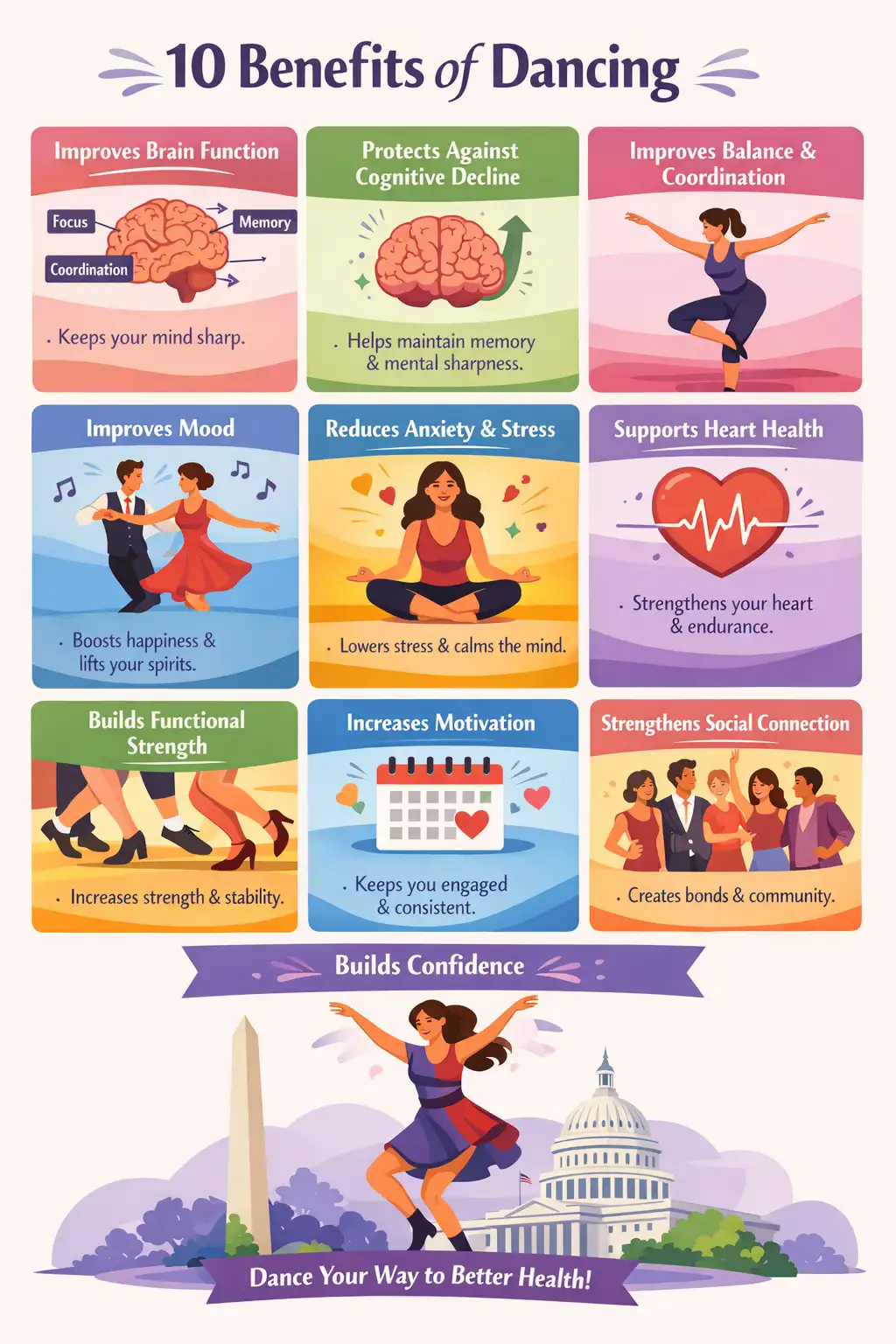
10 most important benefits of dancing:
- Improves Brain Function
- Protects Against Cognitive Decline
- Improves Balance and Coordination
- Improves Mood
- Reduces Anxiety and Stress
- Supports Heart Health and Endurance
- Builds Functional Strength
- Increases Motivation and Consistency
- Strengthens Social Connection
- Builds Confidence
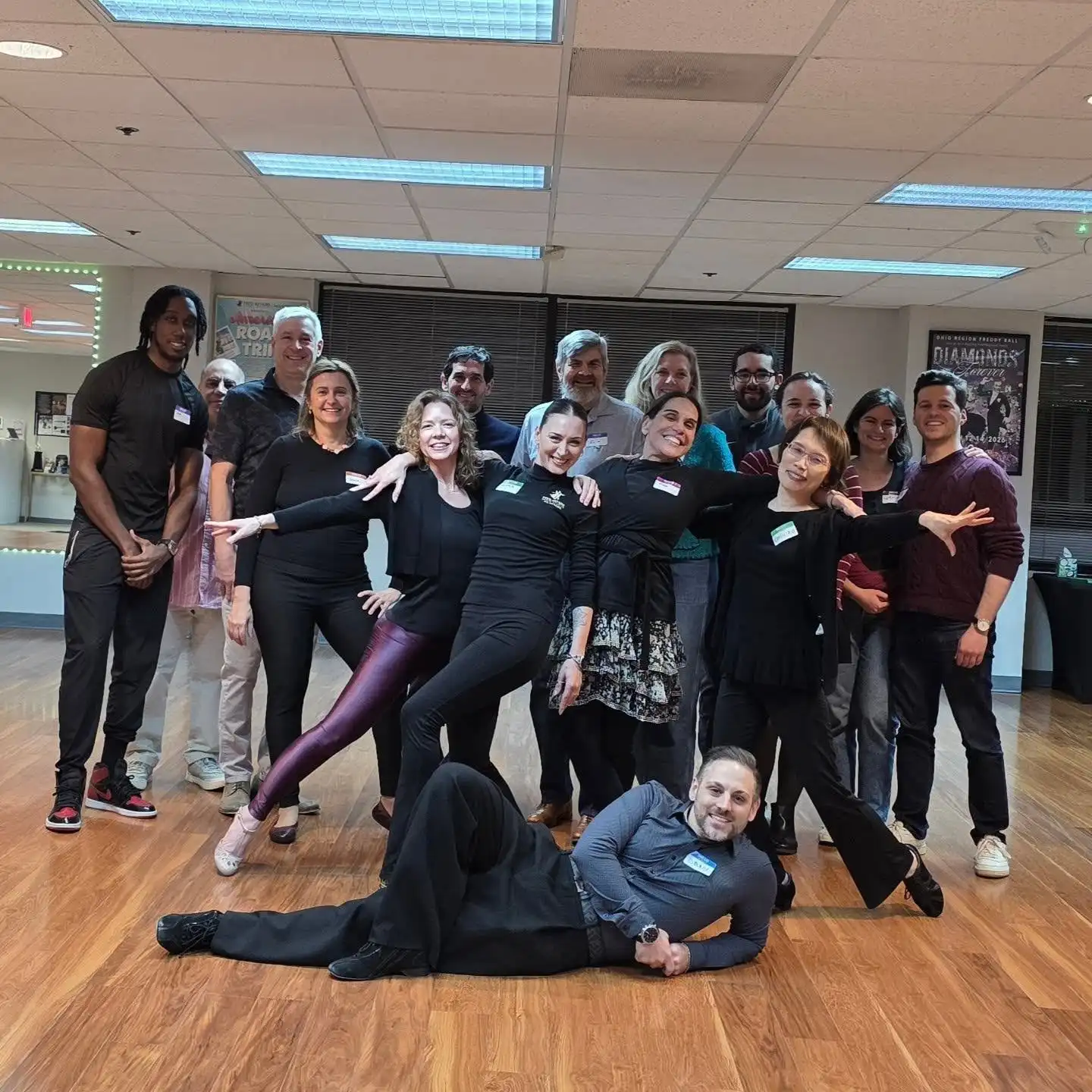
Staying active and mentally balanced can be a real challenge. It can also be difficult to find an activity that supports your health and that you can stay consistent with.
For many, the gym simply is not an appealing option, which is why dance classes can come as a refreshing alternative.
In Washington, DC, more people are discovering how it can transform their approach to health. Dance is not just entertainment. It’s a powerful activity that brings together movement, music, learning, and social connection.
Let’s take a look at the 10 benefits you may not know of yet.
10 Benefits of Dancing
1. Improves Brain Function
One of the biggest benefits of dancing is how it keeps your brain active. Unlike repetitive workouts, it requires you to think, remember, and react in the moment.
It also engages several brain regions, including those responsible for movement, memory, and attention.
| Brain Region | Role in Dance |
| Prefrontal Cortex | Helps with focus, decision-making, and planning movements while learning steps |
| Motor Cortex | Directs body movements and overall physical coordination |
| Hippocampus | Supports memory and helps you remember patterns and choreography |
| Cerebellum | Controls timing, rhythm, balance, and smooth coordination |
Research even suggests that it can physically change the brain. A study published in Frontiers in Human Neuroscience found that regular dancing can increase the size of the hippocampus, the area responsible for memory and learning. It’s also a kind of exercise that increases levels of BDNF, a protein that supports brain cell growth.
This is one reason why dance is linked to a lower risk of cognitive decline compared to other activities.
2. Protects Against Cognitive Decline
Another important benefit is its impact on long-term brain health. With time, it can help maintain memory, focus, and mental sharpness.
As we age, it’s common for certain cognitive abilities to decline. However, activities that involve both movement and learning can help slow this process.
This is why it’s often linked to a lower risk of cognitive decline.
3. Improves Balance and Coordination
A systematic review published in Frontiers in Aging Neuroscience found that dance-based activities can improve balance and posture. This is particularly relevant for older adults, as it minimises the risk of falls.
Of course, the advantages of dancing are not visible after just one lesson. Progress comes from consistency and regular practice. If you are noticing signs of imbalance and are in Washington, DC, trying dance lessons can be a simple and enjoyable way to improve stability.
4. Improves Mood
Physical movement releases endorphins, while music stimulates dopamine, which is linked to pleasure and motivation.
At the same time, this kind of activity allows emotional expression. Instead of suppressing feelings, you can process them through movement.
Because of this, it can have a strong impact on how you feel both during and after a session. That said, it can contribute to reducing stress, lifting your mood, and creating a sense of enjoyment that is hard to find nowadays.
5. Reduces Anxiety and Stress
Mental health benefits are especially visible in stress reduction. Dance lowers cortisol levels and helps regulate the nervous system.
As you focus on rhythm and steps, your attention should shift away from everyday worries. Instead of overthinking, you need to stay present and engaged. This can help interrupt negative thoughts and create a sense of mental relief.
This, in particular, makes it an effective and natural way to manage stress and anxiety.
6. Supports Heart Health and Endurance
It’s also an effective form of cardiovascular training. With regular movement, your heart gets stronger and becomes more efficient at pumping blood and delivering oxygen to your muscles.
This also improves circulation, which means oxygen and nutrients move more efficiently throughout your body. As that improves, you may notice you do not get tired as quickly.
7. Builds Functional Strength
Another key benefit of dancing for health is the development of functional strength. Instead of isolating muscles, it engages multiple muscle groups.
For example, turning, jumping, or balancing requires strength, control, and stability at the same time. Dancing as an exercise improves joint stability and control. Especially around the hips, knees, and ankles, which are essential for safe and efficient movement.
8. Increases Motivation and Consistency
One of the biggest reasons people stick with it is that they enjoy it. When something feels engaging and rewarding, it becomes much easier to stay consistent.
Music, variety, and the sense of progress keep it interesting, so it does not feel like something you have to force yourself to do. Such consistency is what leads to real results. When you keep showing up, the benefits build naturally and become part of your everyday life.
9. Strengthens Social Connection
A big part of what makes it so enjoyable is the social side of it. Moving with others creates shared experiences that bring people closer together.
In places like Washington, DC, a strong dance community makes this even more meaningful. It gives people a chance to meet others, feel included, and be part of something that goes beyond just the activity itself.
10. Builds Confidence
At the beginning, dancing can feel unfamiliar or even a bit uncomfortable. But as you keep going, you’ll start to trust your body more. Movements will become easier, and you’ll feel more confident in your moves. With practice, you may notice that you feel less self-conscious, which can build confidence and allow your personality to come through.
It also gives you a way to express yourself without relying on words.
Frequently Asked Questions
Is Dancing for 30 Minutes a Good Workout?
Yes, just 30 minutes of practice can provide an effective and beneficial workout.
During a 30-minute dance session, your heart rate increases, your muscles are engaged, and your body burns calories. This can help improve cardiovascular health, endurance, and increase energy levels.
Is Dancing Good for Parkinson’s?
Yes, it can be beneficial for people with Parkinson’s disease. Because it helps improve balance, coordination, and movement, which are often affected by the condition.
In addition to the physical benefits, it can also support mental well-being. It provides a structured activity, encourages social interaction, and can help reduce feelings of isolation.
Can Dancing Lower Cholesterol?
It can help lower cholesterol when practiced regularly.
The benefits of dancing for health include helping the body manage cholesterol levels by increasing HDL, which is known as good cholesterol. And reducing LDL, which is considered harmful.
While dance alone may not replace medical treatment, it plays an important role as part of a healthy lifestyle.
Discover the Benefits of Dancing at Our Dance Studio in Washington, DC
While many workouts focus only on physical movement, dance as an exercise also builds memory, rhythm, coordination, and emotional expression.
Our dance studio in Washington, DC, focuses on helping students enjoyably experience these benefits. If you are wondering what age is best to start ballroom dancing, the answer is that it is never too early or too late to begin.
At Fred Astaire Dance Studios Palisades, DC, you can learn a variety of dance styles. Lessons are tailored to your level, so you can progress at your own pace while building confidence and control.
If you’re ready to get started or have any questions, we’d love to hear from you.