Learning ballroom dancing in Washington DC starts with one decision: walking into the right studio. Everything after that is a process, and it’s more accessible than most adults assume.
Most guides on this topic tell you to “find a good studio” and “take lessons consistently” without explaining what either of those things means in practice. As studio owners and world professional dancers/teachers, we’re going to give you something more useful: what ballroom dancing involves technically, what separates a lesson that builds you from one that spins its wheels, and what your first few months could look like.
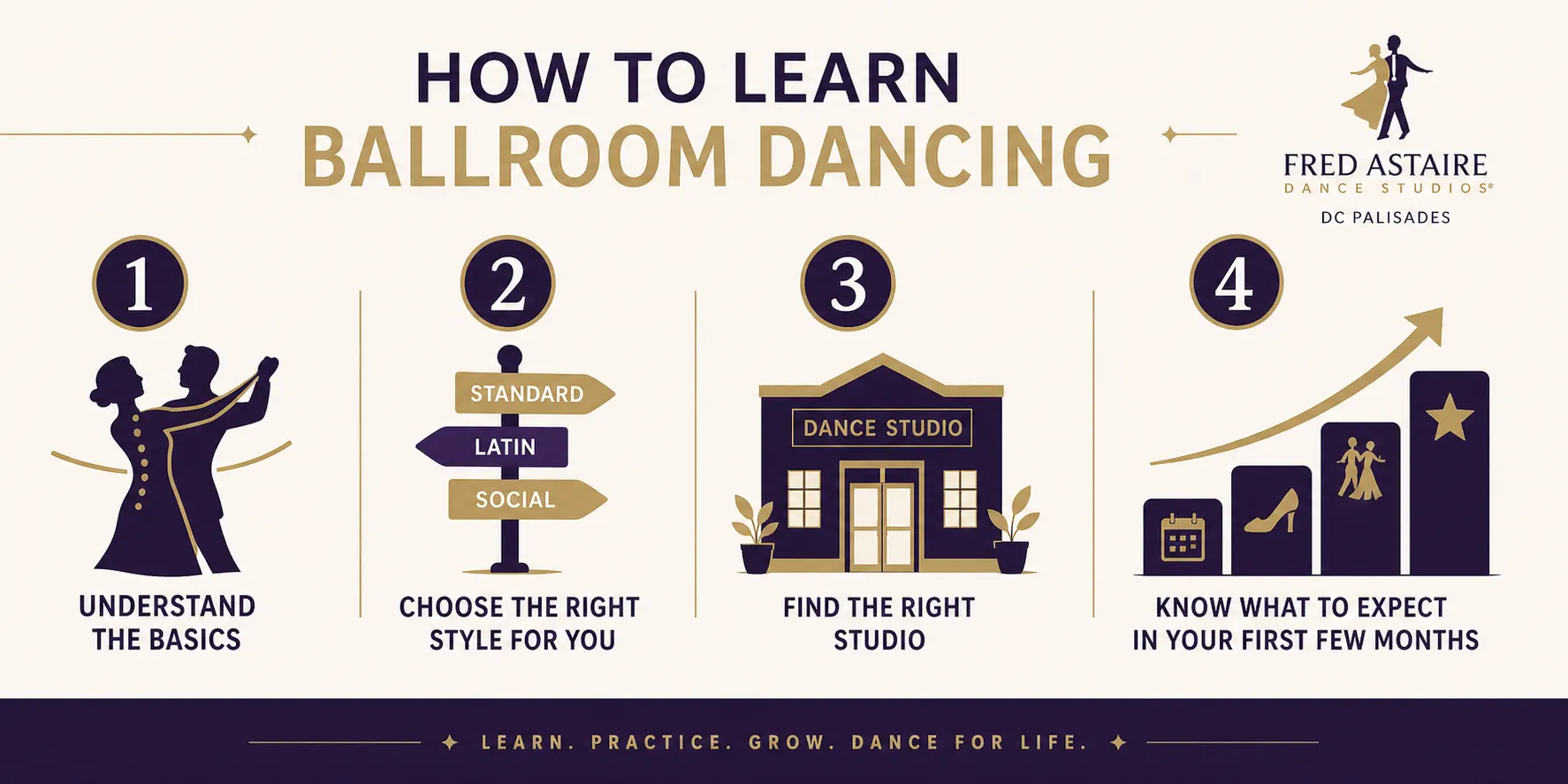
Step 1: Understand What You Are Actually Learning
Before you step into a dance studio in Washington, it helps to know what ballroom dancing is built on. Most beginners think of it as a sequence of steps to memorize. It’s not. Steps are the smallest part of it.
Posture and Frame
Posture is the foundation of every ballroom style. Without correct posture, nothing else works the way it should. In standard styles like the Waltz and Foxtrot, the upper body is held in a lifted position with the shoulders back and down. The core should be engaged, and the head balanced naturally over the spine.
This is not about looking elegant for a performance. It’s about creating a stable structure that allows efficient movement and clear communication with a partner.
Frame refers to the shape your arms create between you and your partner. When that connection is correctly established, two people can communicate direction, timing, and weight without words. A poor frame breaks that communication. A good frame makes it feel effortless.
Weight Transfer and Footwork
Ballroom dancing is fundamentally about how and when you move your weight from one foot to the other. In the Waltz, for example, correct footwork means rolling through the foot from heel to toe on specific beats. This produces the characteristic rise and fall that gives the dance its feeling of floating.
In Latin styles like the Cha Cha and Rumba, the footwork is a little bit different. The knees should stay softer. Weight moves into a straight leg after the knee bends, and that is what creates the hip action in Latin dance. It’s not something you force. It should come from correct footwork, and once students understand that, the movement feels natural instead of forced.
Timing and Musicality
Every ballroom style has a specific relationship with the music. The Foxtrot follows a slow-slow-quick-quick rhythm. The Waltz is counted in three. The Cha Cha uses a syncopated four-beat pattern with a triple step on the and-beat.
A great instructor will teach you how to connect movement to the music. Students who rely only on counting often plateau, because counting breaks down when the tempo shifts or a partner does something unexpected. Musicality, when developed alongside footwork allows the movement to stay fluid and adaptable.
Step 2: Choose the Right Style for Your Goal
If You Have a Specific Event
Waltz and Foxtrot are the most practical starting points for weddings, galas, and formal occasions. Both are learnable to a social standard in 8 to 12 weeks of consistent lessons. The waltz is the most common wedding first dance.
If You Want to Dance Out in Washington
Our city has an active Latin social scene with Salsa nights running weekly across the city. If your goal is to use what you learn outside the studio quickly, Salsa or Cha Cha gives you the most immediate return in the city’s actual dance culture.
For a full breakdown of which Latin style may fit you best, our post on the best Latin dance for beginners in Washington.
If You Are Not Sure Yet
Pick one style and commit to it for 2 months. The most common mistake is switching styles before building any real foundation in the first one. Progress in dancing is cumulative. Skills from one dance transfer to others. Getting solid in a single style is always better than sampling several.
That is exactly what your first dance lesson for adults in Washington with us is for. We’ll talk through your goals, what kind of music moves you, and we will point you in the right direction before you commit to anything.
Step 3: Find the Right Studio
Look at Instructor Credentials
The most important thing in any ballroom dance studio in Washington is the person teaching you. Not the brand on the door. The instructor.
At Fred Astaire Dance Studios DC Palisades, our instructors are world professional finalists. It means we’ve competed on international floors against the best dancers from dozens of countries and have been ranked among the top performers in the world at that level. Getting there requires years of technical refinement that go well beyond what most instructors ever pursue.
In a lesson, that shows up in a very practical way. When they watch you move, they can pinpoint what is actually causing the issue and guide you to the one adjustment that will make the biggest difference right now.
Look for a Structured Curriculum
Skills learned incorrectly in the first month take three months to undo. A studio without a structured progression tends to teach whatever feels engaging in the moment, which produces students who know fragments of many dances but have no real depth in any of them.
We follow the Fred Astaire method, developed and refined since 1947. It sequences the material so each new skill builds onto the last, and tracks progress through a defined ranking system so you always know where you are and what comes next.
Look for Private Lessons, Group Classes, and Socials
Private lessons are where technique gets built. Group classes are where adaptability develops. Practice parties are where confidence actually forms. A studio that only offers one of these formats will limit your progress. We run all three at our DC Palisades studio throughout the year.
Step 4: Know What to Expect in Your First Few Months
Month One: Foundation
Your focus is posture, frame, and the basic step pattern of your chosen style. Most students feel clumsy in month one. That’s normal. You’re building new motor pathways. The discomfort means you are actually learning something.
Months Two and Three: Things Start to Click
This is when students start feeling the music rather than counting it, and partner connection becomes more intuitive.
Students often describe a moment during this stage when it clicks and they realize they’re actually dancing. Not just going through the steps. That shift is real, and it is one of the most satisfying things to witness as instructors.
Month Four and Beyond
Most students are working on a second dance by this point. The first style gets more refined. Personal expression starts to develop within the technique. Competitions and showcases become real options, and many students find that a performance goal accelerates progress.
The students who progress fastest come in at least twice a week in the first three months. The time between sessions is one of the biggest factors in how quickly your skills improve.
Questions We Get About Learning Ballroom Dancing in Washington DC
Do I Need a Partner to Start?
No. Most of our students begin as individuals. In private lessons, your instructor is your partner. In group classes, you rotate through multiple partners. Many students only start dancing with a specific partner after they have built a foundation on their own.
How Long Before I Can Dance Socially?
You can dance socially after 6 to 8 weeks. But at this stage it doesn’t mean executing advanced figures. It means moving to the music with a partner and enjoying yourself. That is achievable within a couple of months for almost any adult who commits to practice!
What Should I Wear?
Comfortable clothes that allow movement and shoes with a smooth sole. Rubber-soled sneakers grip the floor in a way that can strain your knees. You don’t need dance shoes immediately, but if you continue with lessons, a basic pair makes a noticeable difference.
If you are still deciding whether starting is a good option, our post on starting dance classes as an adult in Washington DC is worth exploring.
Start Learning Ballroom Dancing in Washington DC At Fred Astaire Dance Studios
We are at 5185 MacArthur Blvd, Suite 250 in the DC Palisades neighborhood. Our instructors are world professional finalists who work with complete beginners every week, and we would love to show you what ballroom dancing actually feels.
Book your introductory lesson and start dancing with us.