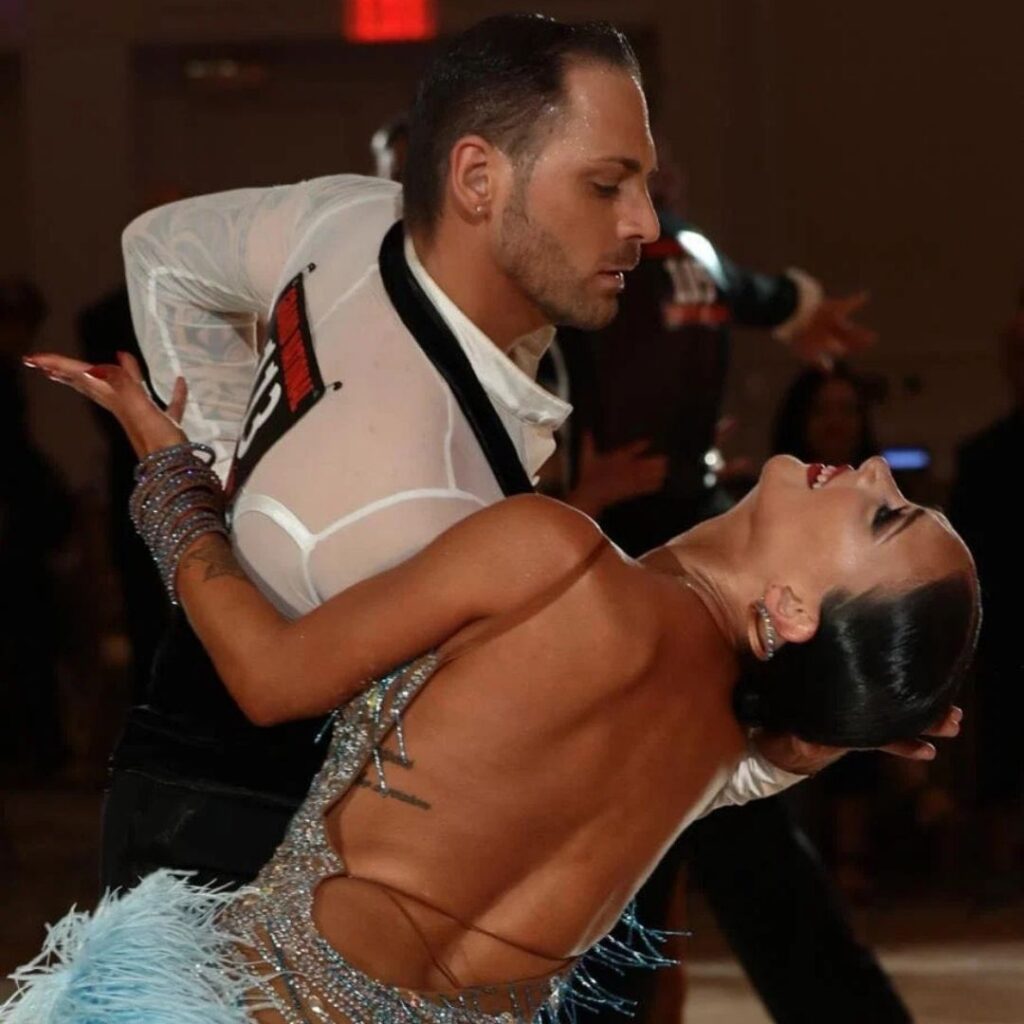
International Latin ballroom dance is a standardized, competitive category of partner dancing that includes five dances: Samba, Rumba, Cha-Cha, Paso Doble, and Jive.
What makes International Latin so engaging is that you aren’t just learning five sets of steps. You’re learning five distinct ways to interpret music and communicate through movement.
Some styles require precision and sharp changes in direction, while others call for smooth weight transfers, rhythmic hip motion, and bold, energetic movement.
Let’s explore what makes each of these styles unique and what you can look forward to if you decide to start with private dance lessons.
What Is International Latin Ballroom Dance?
International Latin is one of two competitive systems in International ballroom dancing, along with International Standard.
While Standard features dances like the Foxtrot, Tango, Waltz, Quickstep, and Viennese Waltz, International Latin focuses on rhythm, expressive movement, and dynamic energy.
Each of the five dances has its own rhythm and unique style. As you learn, you’ll discover how to coordinate your legs, feet, hips, torso, and arms, all while staying balanced and connected with your partner.
In competitions, judges look for timing, technique, movement quality, partnership, presentation, and how well you interpret the music.
Even though International Latin is often seen in professional competitions, you don’t need to compete to enjoy it. The same skills that help competitors shine can help you move with more confidence, improve your coordination, and feel at home on any dance floor.
International Latin vs. American Rhythm
If you’re taking dance lessons in the United States, you’ll often hear about a second Latin-inspired style alongside International Latin: American Rhythm. The two share some dances, but they’re separate systems, each with its own technique and feel.
American Rhythm includes the Cha-Cha, Rumba, East Coast Swing, Bolero and Mambo. So when you start learning Cha-Cha or Rumba, it helps to know which style you’re dancing. The names are the same, but the steps can be quite different.
In American Rhythm, for example, beginners usually learn the Rumba as a box step on a slow-quick-quick count, starting on beat 1. In International Latin, the Rumba basic is counted “2, 3, 4-1,” starting on beat 2. The knee action differs too: International Latin often takes weight onto a straightened leg for sharp, clean lines, while American Rhythm has a softer, more relaxed look.
Which one is right for you depends on your goals. American Rhythm is a natural choice if you mainly want to dance at weddings, parties and social events, since dances like East Coast Swing and Mambo fit easily into almost any celebration. International Latin is ideal if you love its sharp, expressive look, or you’d like to try Latin DanceSport one day. And you don’t have to pick just one. Many dancers learn both, since the timing, posture and weight changes you build in one style make the other easier to learn.
Not sure where to start? Tell your instructor what you’d like to get out of your lessons, and together you’ll choose the style that fits.
What Are the 5 International Latin Dances?
The five International Latin ballroom dances are the Cha-Cha, Rumba, Samba, Paso Doble, and Jive.
Here are the main features of each:
Cha-Cha
The Cha-Cha is a lively and playful style with sharp steps, a syncopated rhythm, and its signature hip movement. The basic is counted over eight beats: “1, 2, 3, 4-and-5, 6, 7, 8-and-1.” The rocking steps fall on 2 and 3, then again on 6 and 7, and each is followed by a quick triple step, the chassé, on 4-and-5 and 8-and-1. That chassé gives the dance its familiar “cha-cha-cha” feel.
A key technique is Cuban motion, the relaxed hip action that comes from bending and straightening your knees with each step, rather than from moving the hips themselves. As your weight shifts from foot to foot, the hips settle into place on their own, so there’s no need to force them.
Samba
Samba is a lively, joyful dance with Brazilian roots, known for its rhythmic bounce and energetic traveling patterns. Unlike many Latin dances that stay mostly in place, ballroom Samba moves around the floor, so couples travel as they dance. Many basic figures are counted “1-a-2, 3-a-4,” with a quick step on the “a” just before the next beat, which gives the dance its bouncy, syncopated feel. The exact timing varies from one figure to another, and your instructor will show you how each one is counted.
A key technique is the Samba bounce, a gentle, rhythmic action that comes from flexing and straightening your knees and ankles in time with the music. It adds a steady pulse to your steps, rather than turning them into jumps. As a beginner, start with small, relaxed movements, and let the bounce grow naturally as your timing and balance improve.
Rumba
The ballroom Rumba is often considered the most romantic and expressive of the five dances. Its slower tempo lets dancers explore musical phrasing, build tension and release, and communicate emotion through subtle movement.
The basic timing is counted “2, 3, 4-1.” You take three steps on beats 2, 3 and 4, and the last step is held through beat 1, which gives the dance its slow, sustained feel. Because each step has time to develop fully, it’s important to focus on steady weight changes and balanced movement.
Rumba also uses Cuban motion, the natural hip action that comes from transferring your weight from one foot to the other, rather than from moving the hips themselves. The slower tempo gives you time to focus on balance, leg action, and the smooth coordination of your upper and lower body.
Paso Doble
Drama, strong posture and bold movement define this dance. Inspired by the Spanish bullfight, it lets you and your partner step into the roles of matador and cape, bringing the story to life on the dance floor. Its name means “double step” in Spanish, a nod to the march-like music it’s danced to.
While Rumba is smooth and romantic, Paso Doble is all about sharp accents, strong shapes and powerful steps. It’s danced to music in 2/4 time, with a strong, marching beat, and you’ll often take one step on every beat. Paso Doble music also has musical highlights, powerful moments where the music builds to a peak, and dancers mark them with a striking movement or a held shape.
Its technique sets it apart from the other Latin dances, too. Instead of the hip action used in Cha-Cha, Samba and Rumba, Paso Doble relies on a lifted chest, a strong frame and steps that often start with the heel, similar to the ballroom Standard dances.
Jive
Rooted in the lively Swing era, Jive is packed with quick footwork, energetic kicks and flicks, and lots of playful changes of direction.
The basic pattern is counted “1, 2, 3-a-4, 5-a-6.” You start with a rock step on 1 and 2, then dance two quick chassés, each made up of three small steps, on 3-a-4 and 5-a-6.
The music is fast, so keeping your timing and staying light on your feet is part of the fun. If you’re just starting, take it slowly at first, then pick up the pace as you build coordination, agility and stamina. Before you know it, you’ll be moving confidently with your partner.
Which International Latin Ballroom Dance Is Best for Beginners?
Rumba is often a great starting point for beginners in International Latin. Its slower tempo gives you time to learn the steps, improve your balance and get comfortable moving with the music. It’s also an easy way to get used to the technique and musical style found in competitive Latin dancing.
One of the first things you’ll learn is how to shift your weight smoothly from one foot to the other. As you get more comfortable, you can focus on Cuban motion, good posture and the controlled movements that make Rumba so expressive. The basic steps are easy to pick up, though the technique takes time and practice to master. And if your main goal is social dancing, ask your instructor whether starting with American Rhythm might suit you better.
Thinking about taking your first steps on the dance floor? At Fred Astaire Dance Studios – Palisades, private lessons make learning easier. Your instructor will explain each new step, help you fix small mistakes and adjust every lesson to your pace and goals, so you can build a strong foundation before moving on to more advanced figures. Learn what to expect from ballroom dance lessons in Washington, DC.
Find Your Favorite Latin Dance at Fred Astaire Dance Studios – Palisades
Everyone has their own reason for dancing. Maybe you want to improve your coordination, feel more confident at social events, learn a new skill, or even compete.
At Fred Astaire Dance Studios – Palisades, private sessions help you find the perfect fit with personalized instruction tailored to your experience level and goals. Once you feel comfortable with the fundamentals, competition lessons can help you refine your technique and strengthen your performance skills. They also give you the opportunity to experience the excitement of Latin dancesport.
Book an introductory lesson today.