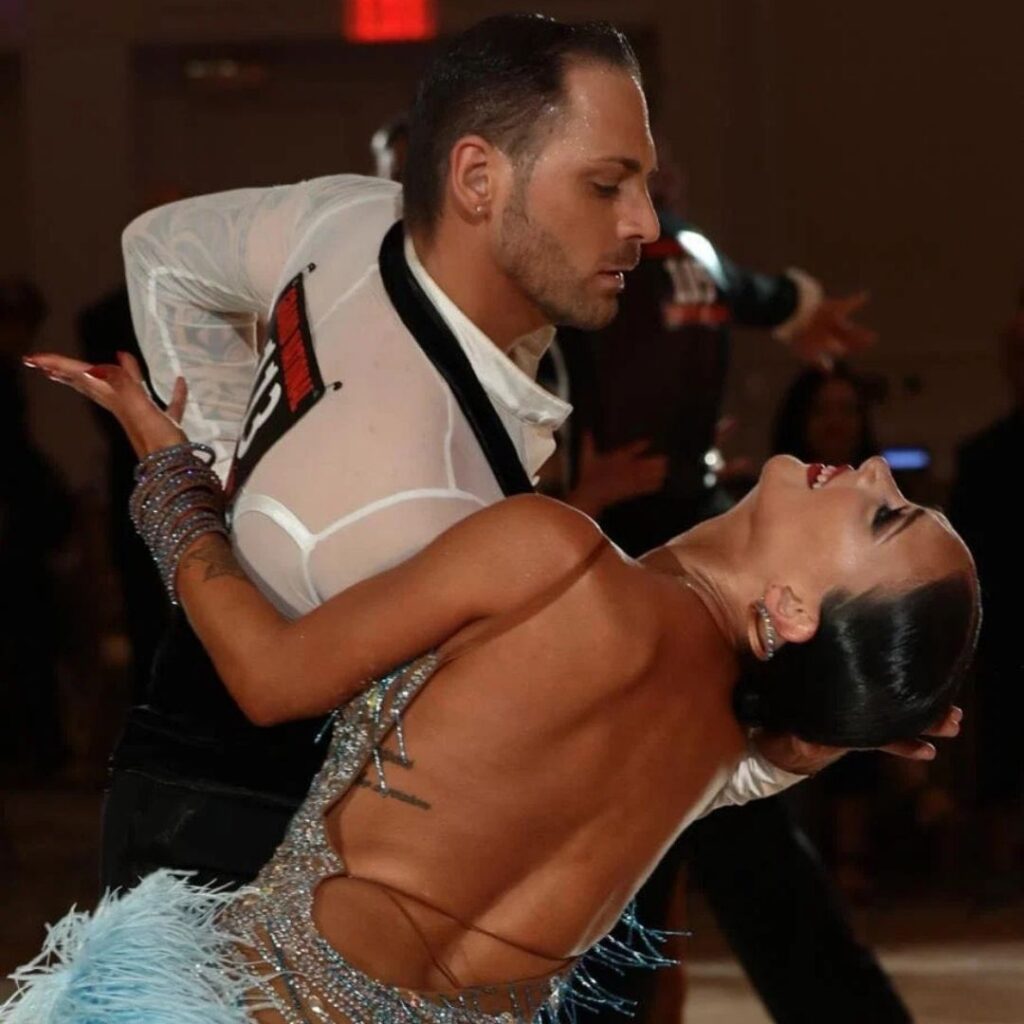
The main difference between Viennese Waltz and Waltz is speed: Viennese Waltz is danced at about twice the tempo, with continuous turns that create a lively, spinning effect. Both share the same elegant, romantic character and flowing movement, but they feel very different. The Waltz, often called the “Slow Waltz,” gives you time to shape each step with smooth rise and fall.
Both are popular at weddings, balls, formal events and social gatherings. But when you start learning them, each one brings its own challenges.
Let’s look at the key differences between the two, and which one might be the better choice if you’re just starting out.
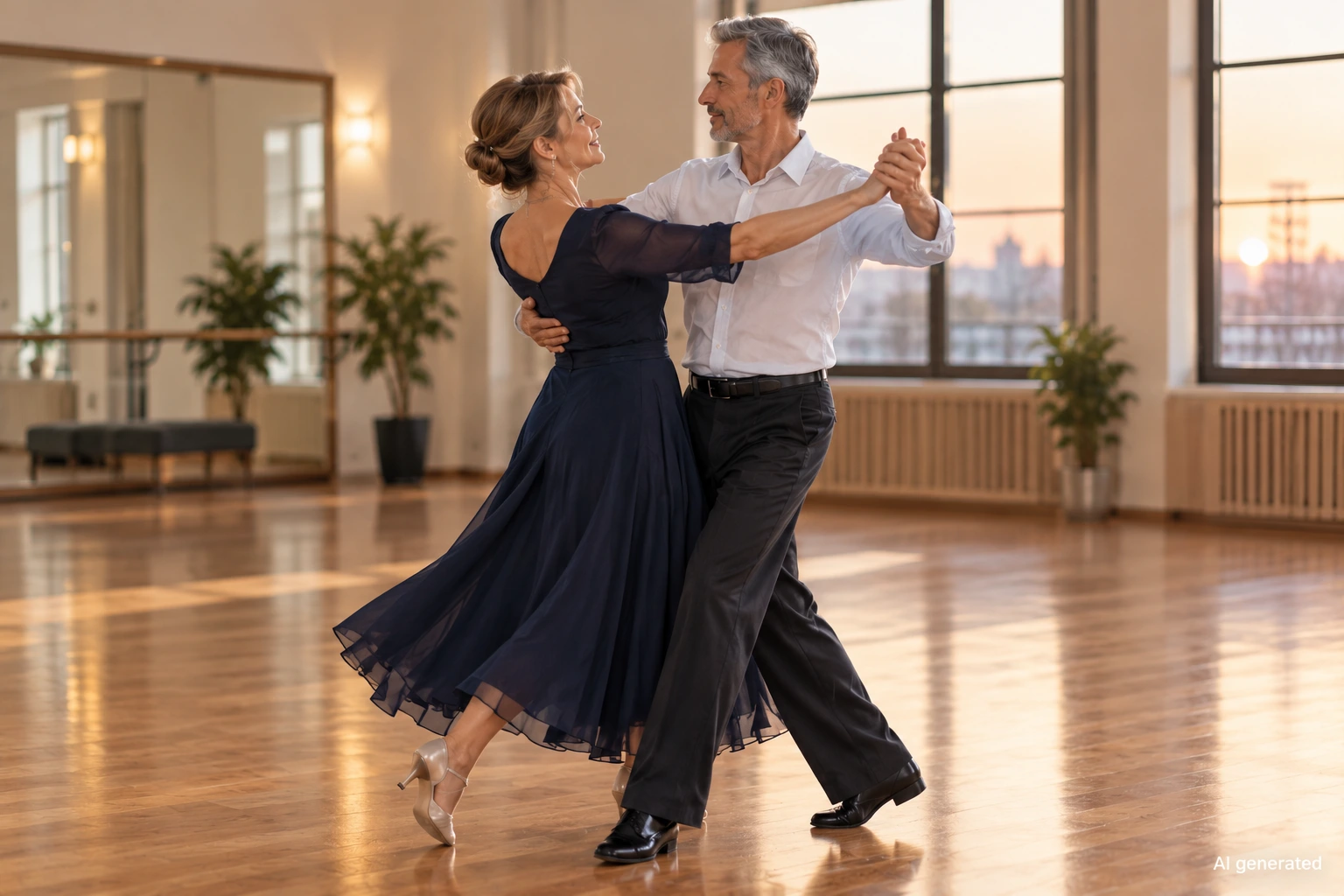
What Is the Slow Waltz?
The slow Waltz is one of the most well-known ballroom dances. Its smooth steps, gentle turns, and graceful rise and fall give it the classic elegance people often think of when they picture ballroom dancing.
The slower tempo allows you to focus on how each movement connects to the next. Instead of simply dancing along to the music, you’ll learn to shift your weight seamlessly, maintain proper posture, and move with your partner as one synchronized unit.
Understanding the Slow Waltz Steps
Most dance studios start with the basic box pattern. It gets its name from the shape traced on the floor, which forms the foundation of this style.
It has a 3/4 rhythm, counted 1-2-3, 1-2-3, with emphasis on beat 1, with a gentle rise and fall through each measure.
Here are the basic steps for the person leading:
- Step forward with the left foot on the first beat.
- Step to the side with the right foot on the second beat.
- Bring the left foot toward the right foot on the third beat.
- Step backward with the right foot on the next first beat.
- Step to the side with the left foot on the second beat.
- Bring the right foot toward the left foot on the third beat.
The follower performs the opposite footwork, starting with a step backward.
Why Learn the Slow Waltz?
It is an excellent choice if you want to build a foundation in ballroom dancing. You’ll focus on posture, foot placement, musicality, and balance before adding more complex turns. It’s also a great option if you are preparing for a wedding or simply want to feel confident at formal events, since dance lessons can improve your social skills.
What Is the Viennese Waltz?
It is a faster ballroom dance known for its continuous turning movements, elegant posture, and sweeping travel around the floor. It possesses a lively, almost spinning quality that makes it particularly striking when danced to traditional Viennese music.
Like the Slow Waltz, the Viennese Waltz uses a 3/4 rhythm. Dancers usually count it 1-2-3, 4-5-6, which covers two bars of music, the six steps of one full turn. The real difference is the tempo: about 50 to 60 measures per minute, compared to around 30 for the Slow Waltz.
Since the music is fast, dancers need to coordinate their steps and turns well. There is little time to pause, adjust balance, or think about each move, so good technique is very important.
The Viennese Waltz has less noticeable “rise and fall” than the Slow one. Dancers still use their ankles, knees, and feet for smooth movement, but the steps are smaller to match the faster speed and constant turning.
Although this dance might seem intimidating at first, you don’t have to start at full speed. If you start with ballroom dance lessons in Washington, DC, you’ll learn footwork and turning techniques first to build coordination and balance before moving to faster music.
Viennese Waltz Steps: The Core Figures
The Viennese style utilizes fewer basic patterns compared to other ballroom dances. However, executing them smoothly requires precise timing and controlled rotation.
In Viennese Waltz lessons in Washington, DC, you’ll start with three key beginner figures: the natural turn, the reverse turn, and the change step.
| Figure | Leader | Follower |
| Natural turn | Steps forward on the right foot, side on the left, and closes the right foot to the left (1-2-3), turning right throughout. Then steps back on the left, side on the right, and closes the left foot to the right (4-5-6) to complete the rotation. | Steps back on the left foot, side on the right, and closes (1-2-3), then forward on the right, side on the left, and closes (4-5-6), turning right throughout. |
| Reverse turn | Steps forward on the left foot, side on the right, and crosses the left in front of the right (1-2-3). Then steps back on the right, side on the left, and closes the right foot to the left (4-5-6). The crossing step lets the couple keep turning left smoothly. | Steps back on the right foot, side on the left, and closes (1-2-3), then forward on the left, side on the right, and crosses the left in front (4-5-6). |
Change steps link the two turns. The natural turn rotates right and the reverse turn rotates left, so you can’t switch straight from one to the other. A change step is a simple forward-side-close that puts you on the other foot, letting you start turning the opposite way without losing the rhythm.
Which Style Should You Learn as a Beginner?
For most beginners, the Slow Waltz is an excellent starting point because it teaches ballroom fundamentals without requiring rapid turns or complex footwork. Its tempo helps you maintain a comfortable dance frame, shift your weight, and coordinate your steps with the music.
One of the best parts is that you can really focus on how you move. There’s no need to rush. You’ll have the chance to practice smooth transitions, graceful rise and fall, and natural turns that help your dancing look and feel effortless.
It’s also a beautiful choice for weddings and formal events. Its elegant movement can turn even a simple routine into something truly memorable.
If you’re thinking about trying Waltz dance lessons in Washington DC, come to Fred Astaire Dance Studios – Palisades.
In our private lessons, we’ll work with you to overcome any challenges you might face, whether it’s timing, balance, or learning to move together with your partner.
Discover the Elegance of Waltz at Fred Astaire Dance Studios – Palisades in Washington, DC
Whether you are preparing for a wedding, celebrating an anniversary, or looking forward to a formal event, learning the Waltz is a wonderful way to make your special day even more memorable.
At Fred Astaire Dance Studios – Palisades, we offer private lessons designed just for you. We’ll guide you through the basics, help you feel comfortable with each step, and work with you to create a routine that feels natural and fun.
Simply fill out our application form to schedule your first lesson. If you have any questions or want to learn more, send us an email at [email protected].