

Yes, East Coast Swing is one of the best dances for beginners. The dance was simplified so that it would be easier to teach and learn. These qualities make it especially appealing to people who are completely new to dancing.
To understand why it works so well for beginners, we’ll look at the key characteristics.
| Feature | Why It Helps Beginners |
| Simple Rhythm | The repeating rhythm helps beginners recognize the timing of the music quickly. |
| Social Dance Style | It’s mostly used for social dancing rather than strict choreography. |
| Adaptable Music | The dance works well with various music. |
| Clear Partner Connection | The clear lead-and-follow structure helps beginners learn how to communicate through movement. |
| Strong Foundation | Skills learned in this dance style transfer easily to other Swing styles. |
This is just a sneak peek of the style. As we continue, we’ll take a closer look at what makes it such a great starting point for new dancers.
East Coast Swing Dance Steps and Structure
While experienced dancers often add spins and creative variations, the structure itself is relatively simple.
In our East Coast Swing lessons for beginners, we introduce steps gradually. Students first learn to recognize the rhythm of the music and develop a partner connection. As their confidence grows, we begin adding turns and stylistic variations.
This progression helps beginners feel successful early in the learning process while still allowing room for creativity as their skills improve.
Basic Steps
Leader’s Steps (start with the left foot):
- Rock step: Step back with the left foot, then shift weight onto the right foot.
- Triple step to the left: Step side with the left foot, bring the right foot next to the left, then step side again with the left (left–right–left).
- Triple step to the right: Step side with the right foot, bring the left foot next to the right, then step side again with the right (right–left–right).
Follower’s Steps (start with the right foot):
- Rock step: Step back with the right foot, then shift weight forward onto the left foot.
- Triple step to the right: Step side with the right foot, bring the left foot next to the right, then step side again with the right (right–left–right).
- Triple step to the left: Step side with the left foot, bring the right foot next to the left, then step side again with the left (left–right–left).
The Social Side
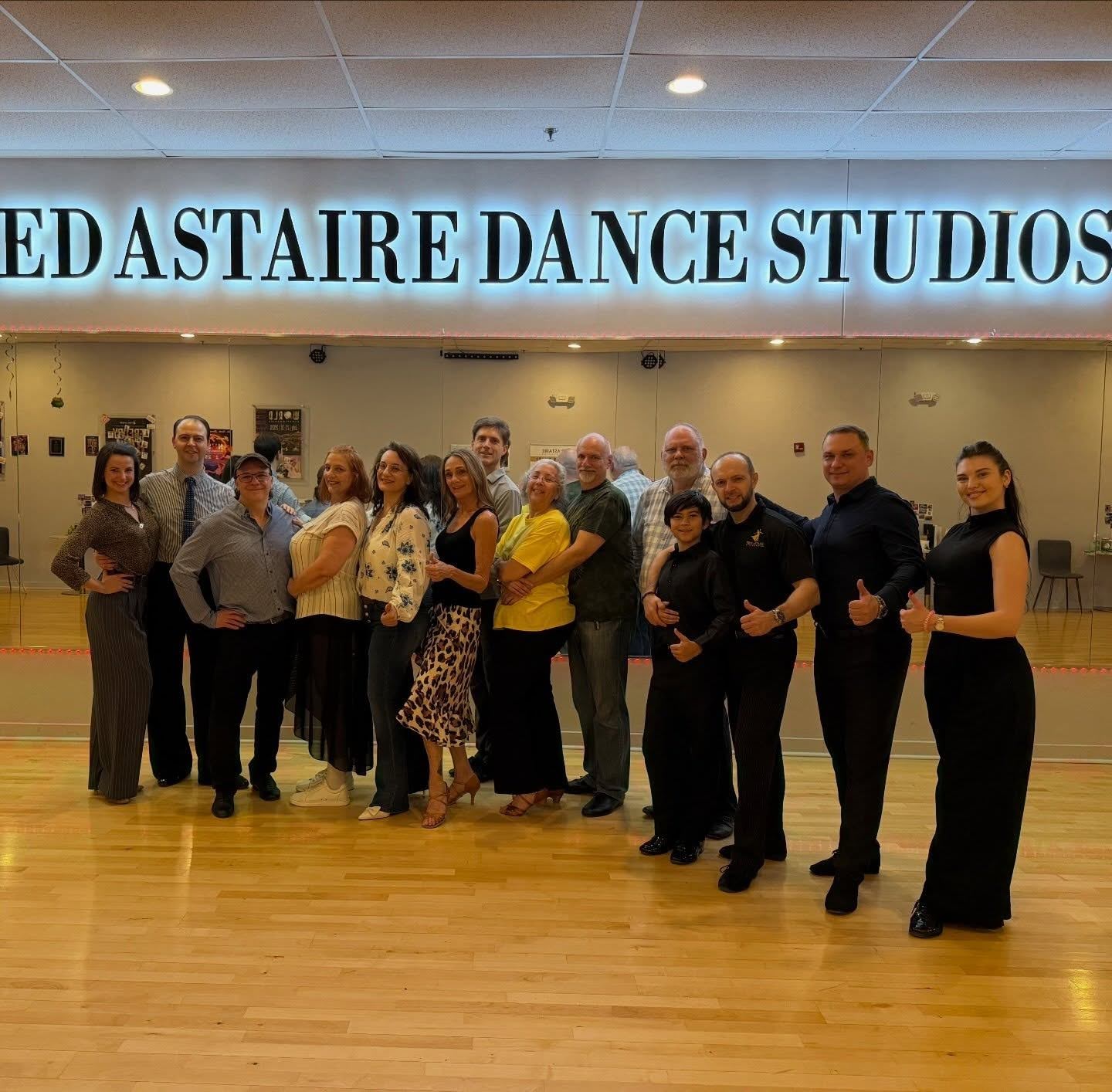
Once you become comfortable with the basics in private lessons, many students choose to continue their learning experience in group classes and studio events.
Learning from your instructor is a great way to build confidence and learn the fundamentals. But there will come a time when you’ll have to dance with other people.
To prepare you for any event, our studio also offers group classes and social events where you have the opportunity to practice learned skills with other partners.
Of course, you don’t have to participate, but if you do, you’ll discover all the benefits of dancing.
Is East Coast Swing Hard to Learn?
From our experience teaching dancing lessons in Apex, NC, most students are pleasantly surprised by how quickly they “can dance.”
Like any skill, improvement takes practice. But the dance itself is beginner-friendly and enjoyable for first-time learners.
What Makes East Coast Swing Unique?
Every dance style has its own personality. East Coast Swing is known for its energetic and playful character.
The partners move together in a circular pattern, rotating around each other while maintaining their connection. This circular motion creates that lively feeling which matches the rhythm of Swing music.
Another defining feature is the interaction between partners. Rather than focusing on memorizing choreography, it encourages communication through movement.
For beginners, this approach is extremely helpful. Instead of worrying about getting every detail perfect, you can focus on feeling the music and connecting with your partner.
This is one of the reasons why it works so well as an introduction to partner dancing.
What Music is Good for East Coast Swing?
Some of the songs you can dance to:
- “Rock Around the Clock” – Bill Haley & His Comets
- “Jailhouse Rock” – Elvis Presley
- “Johnny B. Goode” – Chuck Berry
- “In the Mood” – Glenn Miller
- “Jump, Jive an’ Wail” – Louis Prima
- “Boogie Woogie Bugle Boy” – The Andrews Sisters
- “Crazy Little Thing Called Love” – Queen
- “Wake Me Up Before You Go-Go” – Wham!
- “Candyman” – Christina Aguilera
- “Shut Up and Dance” – WALK THE MOON
- “Valerie” – Mark Ronson ft. Amy Winehouse
What to Expect in Dance Lessons in Apex, NC
For beginners, taking structured East Coast Swing dance lessons can make a huge difference!
During the early stages of learning, students in dancing lessons in Apex, NC, work on:
- recognizing the rhythm
- maintaining a dance frame
- understanding lead-and-follow communication
- moving with a partner
East Coast Swing vs West Coast Swing
Although both dances belong to the same dance family, they are different in terms of style and movement patterns.
Let’s take a look at the table below:
| Feature | East Coast | West Coast |
| Movement Pattern | Circular movement around the floor | Linear movement |
| Social Dance Style | Energetic and playful | Smooth and relaxed |
| Music | Swing, rock and big band | Blues, pop, contemporary |
| Difficulty | Beginner-friendly | Beginner to intermediate |
The Origins of East Coast Swing
East Coast Swing was developed from Lindy Hop. One of the original Swing dances that emerged in the 1920s and 1930s.
While Lindy Hop was exciting to watch, it could be challenging for beginners to learn. And as Swing dancing spread across the U.S., dance studios (as well as ours) began teaching a simplified version that would be easier for social dancers.
This simplified structure eventually became known as East Coast Swing.
Today, it remains one of the most taught dance styles!
Here’s a comparison of the two styles:
| Feature | Lindy Hop | East Coast |
| Rhythm | Primarily an 8-count pattern | 6-count rhythm |
| Social Dance Style | Athletic and improvisational | Simplified for social dancing |
| Difficulty | More complex for beginners | Beginner-friendly |
Are East Coast Swing Lessons for Beginners Worth it?
East Coast Swing lessons for beginners are absolutely worth it!
Learning with professional instructors helps you build a strong foundation, understand the rhythm of the music, and feel confident dancing with a partner.
Instead of trying to piece things together from videos, our structured dance classes in Apex, NC, will help you to progress gradually.
If you’re curious about what the experience looks like, you can also take a look at our Instagram and Facebook, where we regularly share videos from our studio.