

You can practice dancing at home between lessons by reviewing the steps, working on your timing, and repeating the basic movements you learned during the lessons.
Even 10 to 15 minutes of focused dance training can help you review what your instructor showed you and notice any steps that feel tricky.
If you’re not sure how to practice dancing at home, here are a few tips that might help.
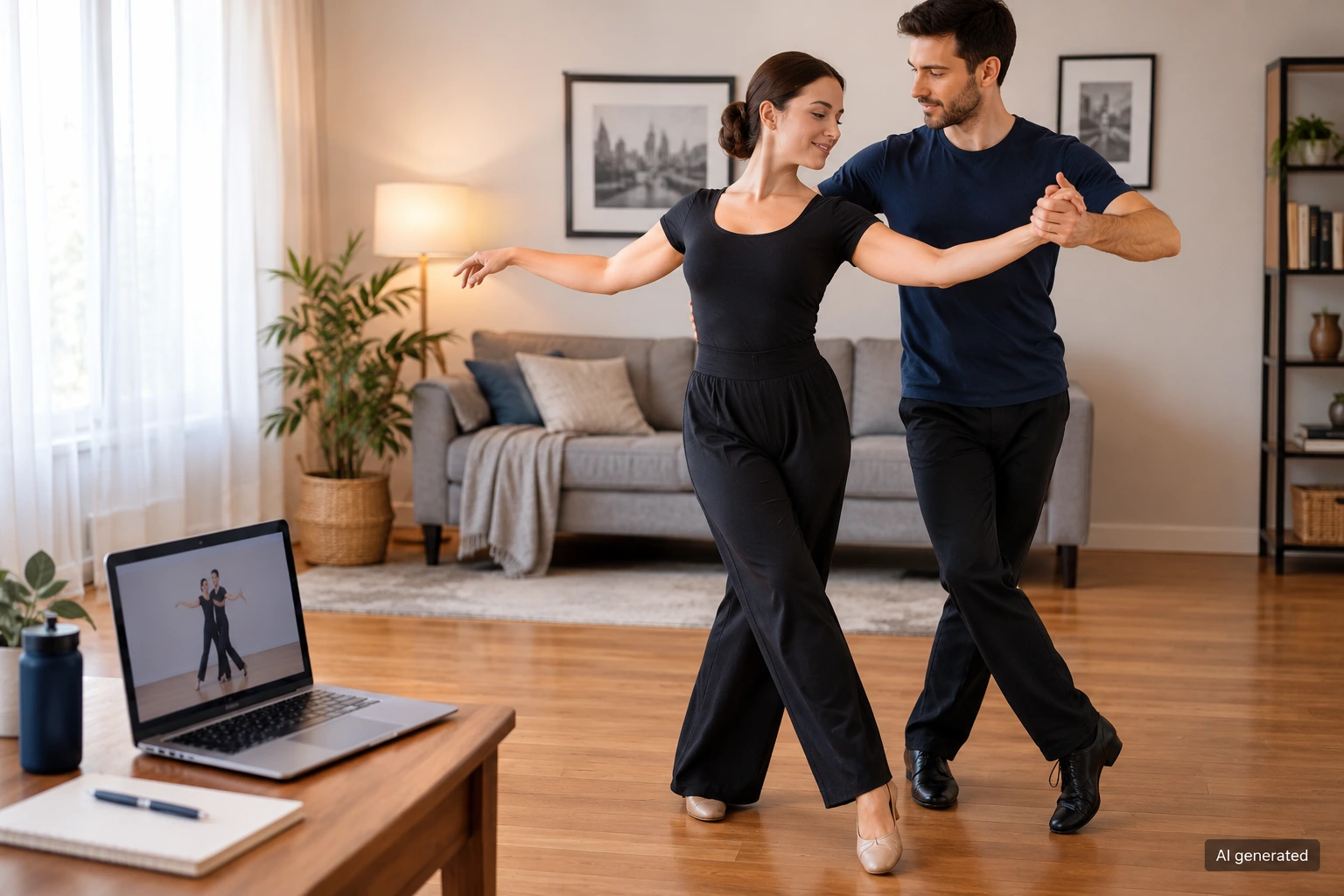
How to Practice Dancing at Home: 5 Useful Tips for Beginners
Start by Reviewing What You Learned in Your Last Lesson
The best way to practice ballroom dance steps at home is to start with the material you’ve already covered with your instructor.
For example, if you learned the basic box step in the Waltz, try practicing the footwork before you add music. If you worked on the Cha-Cha, review the basic timing and make sure you can keep the rhythm steady without speeding up.
If a certain step feels confusing, make a note to ask about it in your next private lesson. Your instructor can go over the movement again and break it down into smaller parts, instead of just asking you to memorize the steps.
Set Up a Practice Space That Works for Dancing
You don’t need a big room or a dance floor to practice the basics. For most beginner patterns, an area of about six by six feet is enough. If you have a hallway or a longer room, use it to practice traveling steps.
The floor makes a bigger difference than the size of the room. Hardwood or laminate is ideal, because it lets you turn and slide your feet the way you do in the studio. Carpet makes turns difficult and can twist your knees, so on carpet, focus on footwork, timing and posture, and save turns for the studio. Clear away rugs and cables, so there’s nothing to catch your feet.
For shoes, choose a pair with a smooth sole, and avoid grippy sneakers that stick to the floor when you turn. If you practice in suede-soled dance shoes, keep them for clean indoor floors, since dirt and moisture can ruin the suede.
A mirror is helpful but not essential. If you have one, use it to check your posture and frame now and then, rather than watching yourself the whole time. In the studio, you’ll be looking at your partner, not your reflection.
Use Music to Improve Your Timing
When you practice ballroom dancing, focus on matching your steps to the music. Practicing at home helps you notice the rhythm, improve your musicality, and dance with more confidence.
Pick a song that fits the style you are learning, ideally one with a clear and steady rhythm. Before you start dancing, listen for a minute and try clapping or counting along. Once you feel comfortable with the basic steps, add the music as you practice.
If you find it hard to keep up, choose slower music and focus on getting your footwork right instead of trying to go fast.
When you can keep a steady beat, try different songs to learn how to adjust your steps to different speeds.
Practice Your Part Without a Partner
Many of the problems that make partner dancing feel difficult, like a wobbly frame, unsteady balance or incomplete weight changes, are easiest to fix when you work on them alone.
Here are three simple exercises:
- The weight change test. Walk slowly through your basic step and pause after every step. If you can lift your other foot off the floor without wobbling, your weight has fully transferred. If you can’t, your weight is stuck between your feet, which is one of the most common reasons beginners feel off-balance or step on their partner’s toes.
- Walking forward and backward. In smooth dances like the Waltz and Foxtrot, you’ll walk forward and backward. Walking forward, lead with your heel and roll through to the ball of your foot. Walking backward, reach back with the ball of your foot first, then lower the heel. Move your body with your foot, rather than reaching with your leg and leaving your weight behind. Practicing backward walks is especially helpful, since most beginners find them harder.
- Holding your frame. Raise your arms into your dance frame and hold it for one full song while you walk through your steps. Check that your elbows haven’t dropped and your shoulders haven’t crept up toward your ears. Holding a steady frame for three minutes is harder than it sounds, and it’s exactly the strength and control your partner will feel in your next lesson.
When your own part feels steady, you’ll be able to focus on connecting with your partner, instead of thinking about your feet.
Practice in Short, Consistent Sessions
A common mistake beginners make is believing that practicing for hours will automatically make them better dancers.
For beginners, 10–15 minutes three or four times a week is enough to practice ballroom dancing. This helps you remember the steps, rhythm, and techniques from your lessons.
What matters most is practicing regularly and knowing what you want to work on.
Begin with a few minutes of basic footwork. Next, count along with the music to help your timing. Then, repeat a move from your last lesson, paying attention to weight changes, balance, and clear steps. End by putting the moves together into a short routine without stopping.
Build Confidence With a Clear Practice Plan
Practicing at home works best when you know exactly what to focus on. That’s where your lessons and your home practice come together.
At Fred Astaire Dance Studios – Apex, your instructor can end each private lesson by giving you one or two specific things to practice before your next visit. In your next lesson, they’ll check how it’s going, fix anything that doesn’t feel right yet and give you the next step to work on. That way, every few minutes you spend practicing at home builds directly on what you’ve learned, instead of repeating the same mistakes.
Call 919-200-4021 to schedule an introductory lesson and discover how we can support your progress both inside and outside the studio.