

Some of the most common beginner ballroom mistakes include looking down at your feet, taking steps that don’t fit the dance, ignoring the music, and expecting perfect results too soon. These habits can affect your balance, timing, posture, and confidence on the dance floor.
The good news is that these mistakes are completely normal, and most beginners run into at least a few of them. Each one is easy to fix with the right guidance and a little practice.
Here are 7 common mistakes to look out for, along with practical tips on how to improve your ballroom dancing skills and how to be a better dancer.
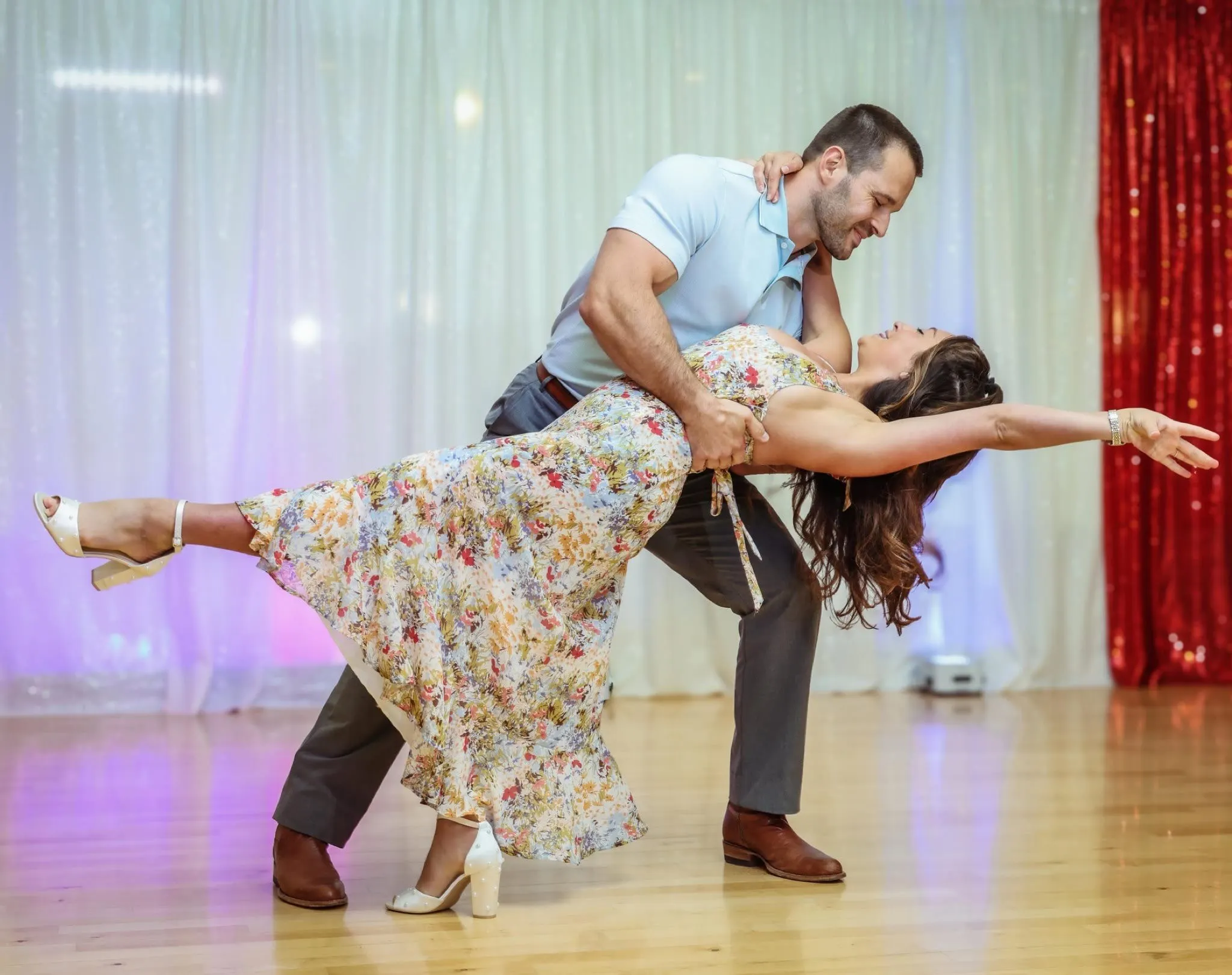
Common Beginner Ballroom Mistakes
Looking Down at Your Feet
Many beginners keep looking down to check their feet. This often happens because they worry about making mistakes or stepping on their partner’s feet. Looking down pulls your head and upper body forward, which throws off your posture and balance and weakens your connection with your partner.
How to fix it:
Keep your head up, relax your shoulders, and look forward. Learn a few basic steps until you can do them without looking down.
Practice and pay attention to how each movement feels. When you feel comfortable with the steps, add music and keep your posture steady.
Taking Steps That Don’t Fit the Dance
Many beginners aren’t sure how big their steps should be, and the answer depends on the dance. In smooth dances like the Waltz and Foxtrot, steps are long and traveling, because the dance moves around the floor. In rhythm dances like the Cha-Cha and Rumba, it’s the opposite: steps are often small and compact, and big steps make it hard to keep up with the quick rhythm and hip action.
How to fix it:
Let your body travel with your foot, instead of reaching with your leg and then catching up. Match your step size to the dance style you’re practicing: longer and more confident in smooth dances, compact in rhythm dances.
Focus on your weight transfer and balance. As you get more comfortable, your instructor can help you adjust your step size for each figure, and on a busy dance floor, you’ll learn to shorten your steps to avoid other couples.
Dancing Without Listening to the Music
Learning the steps is just one part of ballroom dancing. It’s just as important to match your movements to the music. Beginners often get so focused on the steps that they forget to listen to the rhythm. This can make you move too fast, pause awkwardly or fall out of sync with your partner.
How to fix it:
Before you practice a new dance, take a moment to listen to the music. Try to find the beat and count it. Listening to ballroom music outside your lessons also helps you get used to each dance’s rhythm. The better you know the rhythm, the easier it’ll be to move in time with the music.
Trying to Lead or Follow With Too Much Force
In ballroom dancing, the frame is how partners communicate. But beginners often use force: leaders push or pull with their arms, while followers grip, lean or resist. The connection then feels rough, and the signals are harder to read.
How to fix it:
Keep your frame toned but not tense: elbows lifted, shoulders relaxed and down, and arms moving as one unit with your body. Leaders should start each movement from the body rather than the arms, and followers should keep a light, steady connection, so they can feel each signal clearly. Practice holding your frame while you walk through your basic steps at home, and ask your instructor to check it in your next lesson.
Holding Too Much Tension in Your Body
When you’re nervous or concentrating hard, it’s easy to tense up without noticing. Common signs include raised shoulders, locked knees, a clenched jaw and holding your breath. Tension makes your movements stiff, tires you out faster and makes it harder to stay balanced.
How to fix it:
Before you start, take a breath and check yourself from top to bottom: shoulders down, jaw relaxed and knees slightly soft, never locked. Keep breathing as you dance. Holding your breath is one of the quickest ways to tense up. If you feel yourself stiffening during a pattern, pause, exhale and start again slowly.
Expecting Perfect Results Too Soon
One of the biggest mistakes beginners make in ballroom dancing is expecting perfection after just a few lessons. If you compare yourself to experienced dancers or get upset when you forget a step, learning can feel much more stressful than it needs to be.
Ballroom dancing involves many skills that grow together, like musicality, coordination, posture, and connecting with your partner. Building these skills takes time.
How to fix it:
Focus on making progress, not being perfect, and celebrate small wins. Pick one or two moves to practice instead of working on everything at once. Regular practice also helps reinforce what you have learned. Even just 10 to 15 minutes of focused practice between lessons at home can help.
Trying to Learn Too Many Figures Too Quickly
In ballroom dancing, a figure is a set pattern of steps, like a box step or a turn. Watching experienced dancers link figures together can make you want to learn as many as possible. But learning too many figures before mastering the basics can sometimes slow your progress.
How to fix it:
Focus on a few basic figures first, and dance them well, with clean footwork and complete weight changes. At Fred Astaire Dance Studios – Apex, we start with the basics and weight transfer. Once those feel comfortable, we introduce one or two new figures at a time and help you connect them smoothly. Our instructors break more complex figures into smaller parts, so you understand how each one works before moving on.
Fix Beginner Ballroom Mistakes With Private Dance Lessons in Apex, NC
Most beginner mistakes, like looking down, overreaching or holding too much tension, are hard to notice on your own because you can’t see yourself. In a private dance lesson, your instructor can spot them right away and help you correct them before they turn into habits.
At Fred Astaire Dance Studios – Apex, our instructors guide you through the basics, help you fix small mistakes as they happen and support you as you grow at your own pace. That way, you build good habits from the very first lesson.
Ready to get started?
Call us at 919-200-4021 to schedule your introductory lesson, or stop by 1553 Beaver Creek Commons Dr. in Apex, NC.