

If you’ve been thinking about learning how to swing dance, but aren’t sure where to start, you’re not alone. Many people are drawn to swing because it looks joyful, social, and musical, yet hesitate because they worry they’ll feel awkward, off-beat, or behind everyone else in the swing community. The truth is, swing dancing is designed to be learned step by step, even if you’ve never danced before.
At Fred Astaire Dance Studio of Durham, our swing dance lessons are taught to students of all skill levels who want clear guidance, practical skills, and real confidence on the dance floor. Since swing isn’t about flashy moves or natural talent, with the right instruction, beginners can learn how to swing dance in a way that feels structured, approachable, and genuinely fun, without pressure to perform. Join us as we provide tips on how to swing dance with the right technique and footwork.

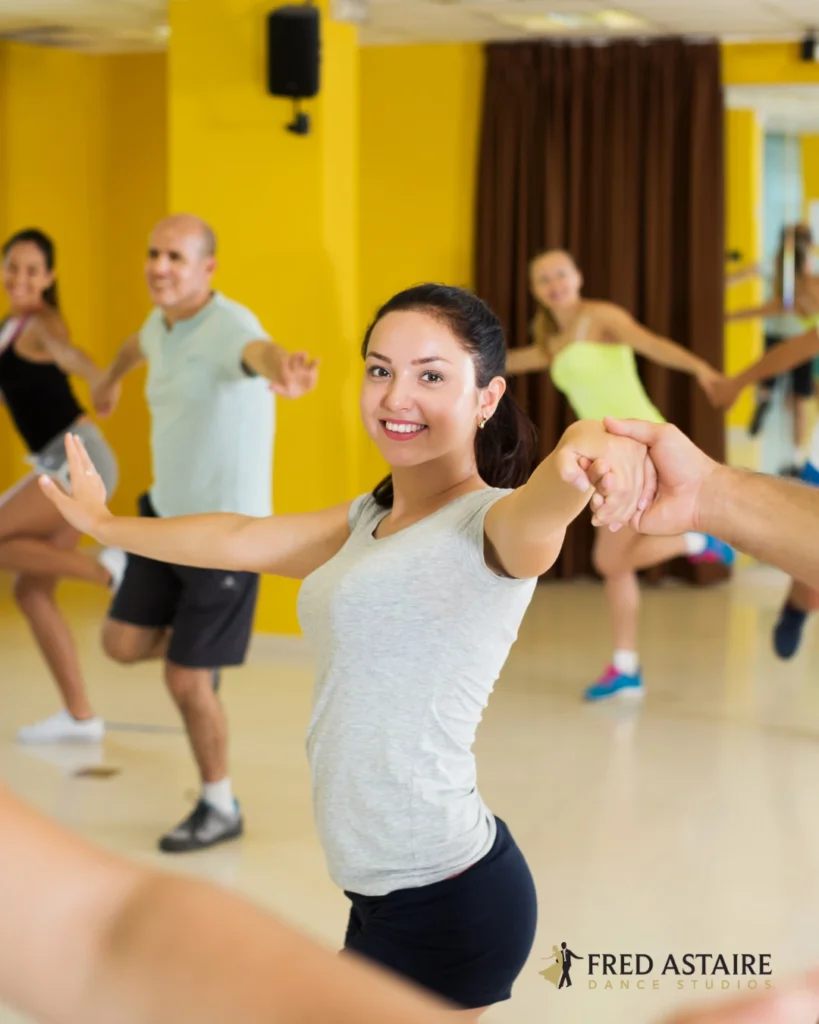
Learning How Swing Dance
Swing dancing is made up of a family of dance styles that developed in the United States during the late 1920s through the 1950s, alongside early jazz and the rise of rock ’n roll music. While people often use “swing” as a single term, it actually includes several related dance forms, each with its own rhythm, footwork, and feel.
What unites all swing styles is their emphasis on rhythm, connection, and momentum.
Swing is usually danced as a partner dance, guided by a lead-and-follow relationship rather than memorized routines alone. That makes learning how to swing dance the ideal choice for social dancing, whether you’re at a dance studio event, wedding, or one of the historic dance halls that helped shape this style.
Lindy hop is the foundation of many swing styles and traces back to Harlem in the late 1920s. It blends six-count and eight-count patterns, allowing for improvisation and athletic movement.
Lindy hop dancers often incorporate:
Inside turn variations
Tandem Charleston or solo Charleston moves
Expressive arm and body movement tied closely to jazz music
Because lindy hop allows freedom, dancers develop their own style over time rather than copying strict choreography.
East Coast swing became widely popular during the American Bandstand era of the 1940s and 50s. It is often the first style taught to beginner dancers. East Coast swing uses a six-count rhythm and simple basic steps, making it approachable and versatile.
East Coast swing emphasizes:
A clear rock step
Consistent triple step
Compact movements that work on crowded floors
Jive developed in the 1940s and 1950s as swing dancing spread internationally, particularly in Europe. It draws from earlier swing traditions while incorporating faster tempos and more energetic movement.
Jive is known for its lively character and sharp rhythmic movements. It uses a six-count structure similar to East Coast swing but is danced with quicker footwork and a more energetic feel, making it one of the more athletic swing-related styles.
Jive typically emphasizes:
Fast, compact footwork
A strong rock step and triple step rhythm
Light, buoyant movement and rebound
Clear musical timing
Today, jive is commonly taught within ballroom dance programs and is danced to upbeat rock ’n roll and swing-influenced music. It offers dancers a way to explore faster tempos while maintaining the foundational mechanics of traditional swing.
West Coast swing is smoother and more linear, danced along a “slot” rather than in a circular pattern. Although it dates back to the 1950s and 60s, it remains popular with new generations of dancers because it works with contemporary music styles as well as blues and jazz.
West Coast swing dancing includes:
Sugar push
Closed position and open position
Controlled weight transfer and stretch
The Hustle emerged in the 1970s, evolving from swing foundations and heavily shaped by disco-era social dancing. While it is rhythmically different from traditional swing styles, it is often grouped with swing in modern studios because it shares similar partner mechanics and adaptability on the dance floor.
The Hustle is typically danced in a linear pattern and emphasizes smooth, continuous movement rather than bounce or sharp directional changes. It is especially popular in social settings where the tempo varies between mellow and upbeat music, making it accessible to dancers of all experience levels.
The Hustle focuses on:
Simple, repeatable footwork patterns
Clear lead-and-follow communication
Smooth turns and traveling movements
Adaptability to different music tempos
Fundamental Footwork to Learn How to Swing Dance
Many beginner swing dancers worry about remembering foot placement. The good news is that most of swing dancing’s footwork is logical and repetitive.
Most swing patterns rely on:
A rock step
One or two triple step patterns
Clear direction changes
Some styles also introduce:
Single-step timing
Footwork variations
Six count variations and eight count phases
A sugar push
Six-count footwork variations form the foundation of many swing dance patterns and help dancers stay aligned with the music. This rhythm emphasizes clear weight changes and consistent timing rather than large movements:
Rock step back on the right foot
Recover weight to the left foot
Triple step (left–right–left)
Triple step (right–left–right)
Instructors often cue dancers to stay aware of both the left foot and right foot, as well as moving in the same direction as their partner. With repetition, this pattern becomes instinctive and begins to flow naturally with the music.
Triple-step swing refers to the characteristic rhythm used in many swing patterns, built around quick, light steps that match the swing music’s pulse. It helps dancers maintain timing while transitioning smoothly between movements:
Reinforces swing rhythm and musical timing
Supports fluid movement between patterns
Keeps footwork light and responsive
An inside turn is a basic rotational movement where the follower turns toward the leader’s center line. It introduces directional changes while reinforcing clear lead-and-follow communication:
Teaches controlled turning technique
Improves coordination between partners
Common across multiple swing styles
Send outs and returns describe movements where partners separate and reconnect in a controlled, rhythmic way. These patterns help dancers learn spacing, timing, and how to reestablish connection smoothly:
Builds awareness of distance and timing
Reinforces connection through movement
Helps dancers transition between open and closed positions
A rock step is a foundational swing movement in that creates rhythm and momentum at the start of many patterns. It involves a small step back and a return forward, focusing on shifting body weight rather than traveling across the floor:
Establishes timing and balance
Prepares the body for turns and triple steps
Keeps movement grounded and controlled
A sugar push is a common swing dance choreography, especially in West Coast swing, that emphasizes the connection between partners. Instead of traveling, dancers move toward each other and then away, using controlled weight changes:
Teaches lead-and-follow connection
Uses smooth compression and stretch
Often danced from a closed position
Book Your First Durham Swing Dance Lesson Today
If you want to learn swing dancing in a way that feels approachable, accurate, and genuinely enjoyable, working with experienced instructors makes all the difference. Swing is social, musical, and endlessly adaptable, so once you understand the basic swing moves, it becomes one of the most rewarding dances to learn.
Contact the Fred Astaire Dance Studio of Durham today. We offer a new-student introductory rate, with your first 2 dance classes priced at just $59. Book your first lesson today by calling [phone] or filling out our contact form to get started.