

Welcome to our lesson on footwork in ballroom dancing.
In our first lesson, we explored how a strong, balanced posture creates the foundation for every dance movement. In Lesson 2, we focused on frame. The connection between partners that allows dancers to communicate and move together.
Now, it’s time to take that foundation one step further: footwork in ballroom dancing.
Beautiful ballroom dancing isn’t only about how you connect with your partner. Your feet are what actually move you across the floor. Learning how to place, transfer, and control your weight correctly can make your dancing feel more natural and balanced.
Why Is Footwork in Ballroom Dancing So Important?
Think of your feet as the foundation of your dance. Even with excellent posture and frame, incorrect footwork can make movements feel uncomfortable or disconnected. Good footwork helps you maintain balance, control your weight and create smoother transitions.
Every step has a purpose. What you need to know:
- Which foot moves first
- Where your foot should be placed
- How to transfer your weight
- Which part of the foot touches the floor
- How to prepare for the next movement
These details may seem small when you’re starting, but they become important as you progress.
Ballroom Dance Footwork Tips for Beginners
Don’t worry about making every movement perfect immediately. Footwork is a skill that develops through repetition, awareness, and practice.
Here are a few tips we regularly share with our students.
1. Understanding Weight Transfer
When you take a step, your body weight needs to move with your foot. Placing one foot forward without properly transferring your weight can leave you feeling unstable or make it difficult to take the next step.
For beginners, this is often one of the biggest adjustments. If you’re new to ballroom dancing, you may find it helpful to explore our guide, 5 tips for beginner dance lessons.
2. Pay Attention to Your Feet
Beginners often focus so much on their upper body that they forget what their feet are doing.
Your posture and frame are important, but your feet need attention too. Listen to the rhythm, feel the floor, and become aware of how each step begins and ends.
3. Avoid Taking Steps That Are Too Large
One common beginner mistake is trying to make every step bigger. In ballroom dancing, larger steps aren’t automatically better. The correct size depends on the dance, the movement, your partner, and the space around you. Focus on control rather than distance.
4. Keep Your Movements Comfortable
Your feet should support your movement rather than fight against it. Do your steps feel forced or uncomfortable? It may be a sign that your weight placement, alignment, or step size needs adjustment. This is where working with an instructor can be helpful.
During a private ballroom lesson, your instructor can help you improve every aspect of your footwork. Including weight transfer, foot placement, timing, balance, step size, and coordination with your partner. For beginners, personalized guidance can make steps easier to understand and practice. Small adjustments in your footwork can make a big difference.
Dance Footwork for Beginners: Practice With Purpose
When practicing footwork as a beginner, quality is more important than simply repeating steps hundreds of times. Instead of rushing through an entire routine, choose a small section and practice it slowly.
For example, you might practice:
- Starting position
- First step
- Weight transfer
- Second step
- Transition into the next movement
Repeat the sequence until it begins to feel natural. Add your posture and frame. Then add rhythm. Finally, connect it to the next part of the dance. This approach allows you to build skills progressively instead of trying to master everything at once.
Your Feet and Your Partner Must Work Together
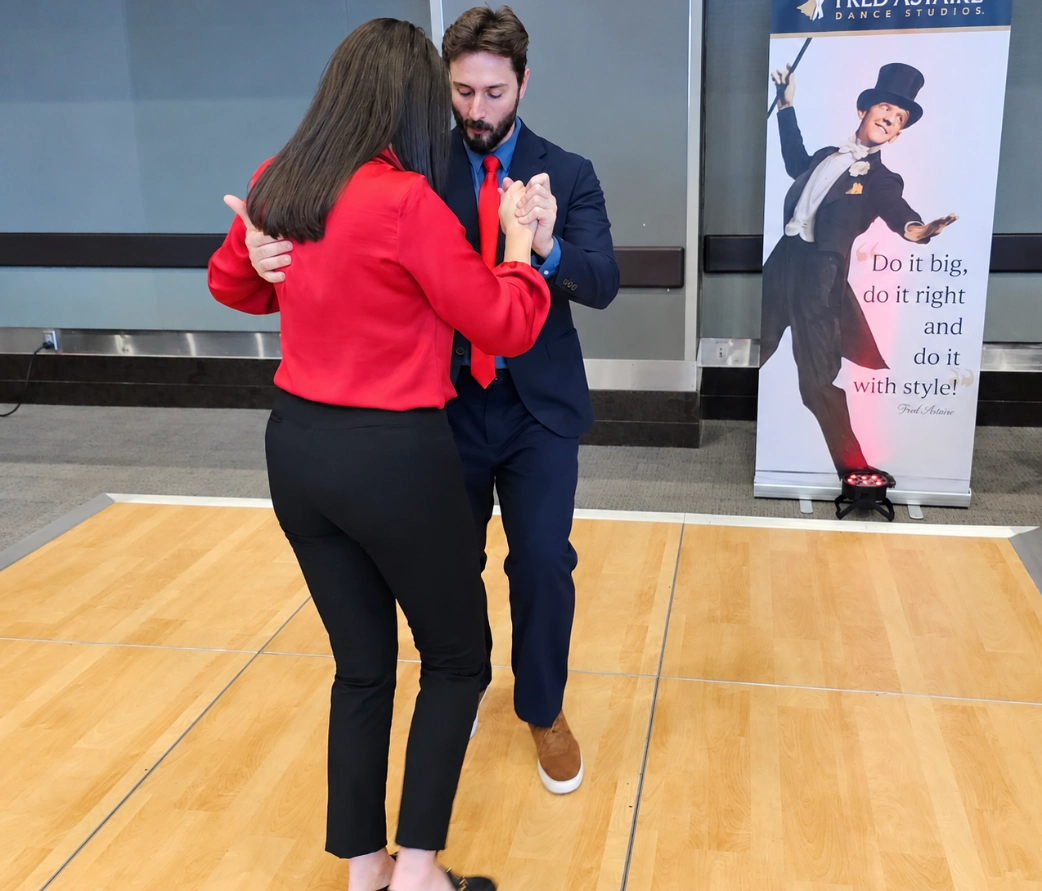
Ballroom dancing is a partnership. That means your footwork isn’t happening independently. Your steps have to work with your partner’s movement. This is where the lessons from our previous two articles – posture and frame – come together.
Your posture gives you balance and alignment. Your frame helps create connection and communication. Your footwork allows you to move.
When these three elements work together, dancing becomes much more coordinated and enjoyable. You begin to stop thinking about every individual movement and start experiencing the dance as a connected sequence.
Different Dances, Different Footwork
Another important thing to understand is that ballroom dances don’t have one universal footwork technique. Different dances have different rhythms, styles, timing, and movement characteristics.
A Waltz has smooth, flowing movement, while Tango has sharper, more grounded steps, without the rise and fall of the Waltz.
In smooth, traveling dances like the Waltz and Foxtrot, forward steps usually begin with the heel and roll through to the ball of the foot, which helps you glide across the floor. In Latin and Rhythm dances like the Cha-Cha and Rumba, steps usually begin with the ball of the foot, keeping your weight forward for quicker, sharper movement.
The type of dance can also influence the kind of footwear you use. Ballroom and Latin dances require different dance shoes because the movement and footwork are different.
For beginners, the most important thing is to choose footwear that is comfortable, secure, and appropriate for the style you are learning. Wearing the right dance shoes can make it easier to move naturally, maintain balance, and develop proper footwork.
Improve Your Footwork With a Professional Dance Studio in Saratoga Springs, NY
Good footwork is hard to fix on your own, because most of the details you need to change are ones you can’t see while you’re dancing: where your weight sits, whether you’re stepping heel or toe first, how far apart your feet are. In a private lesson, your instructor watches every step and corrects these small habits right away, before they become hard to break.
At Fred Astaire Dance Studios – Saratoga Springs, our instructors work with you on footwork, timing, posture and frame, at a pace that suits you. You don’t need any experience or a partner to get started.
Call us at 518-587-0300 or claim our introductory offer via our website. You’ll find us at 3257 Route 9, Suite 2, Saratoga Springs, NY 12866.