

In our first three lessons, we covered three essential foundations of ballroom dancing:
Lesson 1: Posture – how to hold your body with balance and confidence.
Lesson 2: Frame – how partners create connection and communicate through movement.
Lesson 3: Footwork – how your feet, weight changes, and body movement create the dance itself.
Now we are ready for something that brings all three together: timing and rhythm.
If you’ve ever watched a couple dance and thought, “They aren’t doing anything complicated, but they look amazing,” you’re probably noticing more than their steps.
You’re noticing their timing.
You’re noticing how naturally they move with the music.
You’re noticing that their movements seem to belong to the music rather than simply happening while music plays in the background.
That is the difference timing and rhythm can make. And it’s one of the skills we help our students develop every day at Fred Astaire Dance Studios – Saratoga Springs.
What Is Timing in Dance?
Timing is knowing when a movement should happen in relation to the music.
Every ballroom dance has its own timing patterns. The steps are not random. They’re designed to fit within the musical structure of the dance.
Depending on the style, you may hear counts such as:
- 1-2-3
- Slow-Slow-Quick-Quick
- 1-2-Cha-Cha-Cha
But knowing the count isn’t the same as understanding timing.
A beginner may be able to repeat “1-2-3” perfectly while standing beside the instructor, but then lose the timing as soon as the music starts.
Rhythm Gives Each Dance Its Personality
Timing tells you when to move.
Rhythm helps determine how those movements relate to the music.
For example, the Waltz has a smooth, flowing three-beat rhythm. The movement has a natural rise and fall and an elegant quality.
Cha Cha is completely different. It has a distinctive rhythmic character that feels energetic, playful, and precise.
This is where musicality in dancing becomes important. Musicality is the ability to interpret the music through movement. This includes its rhythm, tempo, accents, and mood.
Rather than simply following the beat, dancers learn to express the character of the music through steps and body movements. Developing musicality helps ballroom dancers move with greater confidence, connection, and expression.
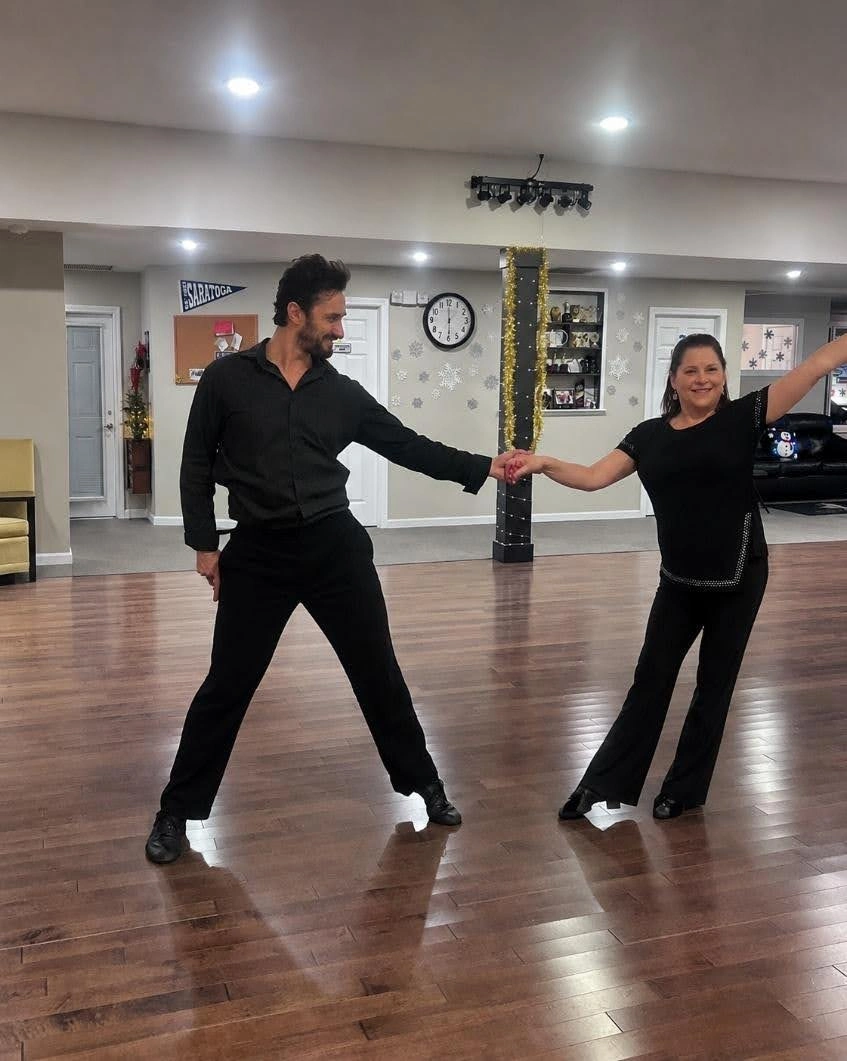
Why Do Beginners Struggle With Timing?
There are several common reasons.
1. Concentrating Too Much on The Feet
This is completely normal. When you’re learning something new, your brain naturally focuses on what it can see.
“Where does my left foot go?”
“Am I supposed to step forward or backward?”
While you’re thinking about all of that, the music continues. Before you know it, you’ve missed the beat.
That’s why a good dance school builds skills progressively, instead of expecting beginners to think about everything at once. At our studio, you’ll first learn a pattern slowly, without music, until your feet know where to go. Then we add the rhythm, and finally your posture and partner connection.
2. Rushing the Steps
Another common problem is moving too quickly. A student hears the next beat coming and tries to get to the next position as quickly as possible.
But ballroom dancing isn’t a race. The goal isn’t simply to arrive at the next step. It’s to arrive at the right time.
3. Believing You Have No Rhythm
We’ve heard this many times: “I have absolutely no rhythm.” Fortunately, that isn’t a permanent condition. Rhythm is a skill that can be developed.
You don’t need to walk into a dance studio already knowing how to hear every beat or understand every musical pattern. That’s what lessons are for. At our dance studio in Saratoga Springs, our teaching methods help students become more comfortable with music and movement.
4. Focusing Only on Staying on the Beat
Staying on the beat is important, but good timing goes beyond that.
It also involves:
- Knowing when to begin a movement.
- Understanding how long a movement takes.
- Controlling weight changes.
- Coordinating with your partner.
- Recognizing the rhythm of the dance.
- Understanding when movement should be smooth, sharp, quick, or sustained.
- Knowing how the music affects the quality of your movement.
That’s why timing is hard to learn from a video, as it can’t tell you if you’re rushing or being late. An experienced instructor can see exactly where your timing slips, explain why it’s happening and show you how to fix it.
5. Adding a Partner
Timing becomes even more important when you’re dancing with another person. When you dance alone, you only have to coordinate your own movement with the music. In ballroom dancing, you have another person to consider.
Your partner needs to know when you’re moving. You need to recognize their movement. Both of you need to stay connected. And both of you need to relate your movement to the same music.
This is where the posture, frame, and footwork we discussed in our previous lessons become so important. When these skills work as a team, partner dancing becomes much more comfortable.
What Happens When You Lose the Rhythm?
It happens to everyone. Even experienced dancers occasionally lose their place. The important thing is learning how to recover.
A common beginner reaction is to rush because they believe they need to “catch up” with the music. Usually, that makes things worse. An instructor can teach you how to recognize when you’ve lost the rhythm, simplify the movement, reconnect with the beat, and continue dancing without becoming overwhelmed. This is one of the advantages of learning in person.
Improve Your Timing and Rhythm at Our Dance Studio in Saratoga Springs, NY
Posture, frame and footwork give you the foundation. Timing is what brings them together and makes your dancing feel connected to the music. Once you start hearing the rhythm and moving with it naturally, partner dancing becomes smoother, more relaxed and far more enjoyable.
At Fred Astaire Dance Studios – Saratoga Springs, our instructors help you hear the beat, find the rhythm of each dance and match your steps to the music, at a pace that suits you. In a private lesson, your instructor can see exactly where your timing slips and show you how to fix it right away. We work with complete beginners, experienced dancers, couples and singles.
Fill out the form on our website to claim our introductory offer and book your first lesson.