

7 Powerful Reasons Dancing Makes You Smarter (Use It or Lose It!)
Meta description: Discover how dancing makes you smarter by strengthening memory, boosting brain health, and protecting against dementia—plus how ballroom lessons at Fred Astaire Dance Studios make it fun to “use it before you lose it.”
Ballroom dancing isn’t just a fun night out or a graceful hobby; frequent dancing apparently makes you smarter, keeps your brain agile, and may even help protect you from dementia as you age . More and more research shows that dancing makes you smarter, keeps your brain agile, and may even help protect you from dementia as you age. At Fred Astaire Dance Studios, we see it every day—students walk in for the social fun or fitness, and end up discovering a powerful mental workout hiding inside every step, spin, and turn.
In this article, we’ll unpack why dancing is so good for your brain, what that famous long-term study really found, and how ballroom dancing in particular builds memory, focus, and confidence for life.
Introduction to Dance and Health
Dancing isn’t just your ticket to a fabulous Friday night—it’s actually a powerhouse of health benefits that’ll make both your body and mind thank you. Here’s the amazing part: research shows that when you’re out there dancing regularly, you’re boosting your mental sharpness, cranking up those feel-good serotonin levels, and get this—you’re getting the best protection against dementia compared to pretty much any other activity out there. Dancing has been shown to significantly improve cognitive acuity, enhancing memory and brain function for people of all ages. Whether you’re gliding through a classic waltz, nailing those smooth foxtrot patterns, or diving into any other ballroom style, every single step you take is building a healthier, more vibrant you.
The magic of dancing doesn’t stop when the music ends, though. Studies in the England Journal of Medicine have shown something pretty incredible: regular dancing doesn’t just keep you moving—it’s actually rewiring your brain for the better, enhancing your cognitive sharpness and creating new neural connections like a boss. According to research from Stanford University and Richard Powers, dance increases cognitive acuity at all ages, providing authoritative support for these brain-boosting benefits. Unlike other activities that might work just one part of you, dancing challenges your brain to forge fresh neural pathways, keeping you sharp and engaged no matter what age you are. Sure, this is especially fantastic news for our seasoned dancers, but here’s the thing—young dancers are seeing these amazing benefits too.
From better balance and coordination to increased happiness and deeper social connections, the health benefits of dancing are honestly mind-blowing. Regular dancing has been proven to contribute to better brain health, improved mood, and a lower risk of cognitive decline. For the elderly, dance is particularly effective in supporting brain health and reducing the risk of dementia, as research highlights its unique impact on this population. It’s this beautiful activity that brings people together, gets you moving in the most enjoyable way possible, and makes staying healthy feel like the best kind of fun you can have.
So whether you’re stepping into your very first ballroom class or you’re already head-over-heels in love with spending time on the dance floor, here’s what we want you to remember: every dance is literally a step toward a brighter, more connected, and healthier future. With so many incredible styles to explore and countless benefits waiting for you, there’s never been a more perfect time to discover how dancing can completely transform your life.
The Science Behind Dancing and Brain Health
Ever wonder why you feel like you’re floating on cloud nine after a night of dancing? You’re not imagining things—science has your back on this one. Turns out, frequent dancing is basically like sending your brain to the gym, except way more fun and with better music. Research shows it’s one of the most powerful activities for boosting mental sharpness, building neural connections, and even keeping dementia at bay.
Get this: In a landmark 21-year study of adults 75 and older, researchers at the Albert Einstein College of Medicine tracked how different leisure activities affected the risk of dementia. The results, published in the New England Journal of Medicine (https://www.nejm.org/doi/full/10.1056/NEJMoa022252), showed that frequent dancers had a remarkable 76% lower risk of developing dementia compared with those who rarely danced.
So what’s actually happening upstairs when you’re gliding across the floor? Every time you nail a new step or pick up a fresh style, your brain is working overtime creating brand-new neural pathways. This amazing process—called neural plasticity—is basically your brain’s way of staying flexible, sharp, and ready for anything. Whether you’re flowing through a waltz or finding your groove in a foxtrot, you’re not just moving your body. You’re giving your brain the workout of its life, building connections that boost memory, focus, and quick thinking.
But here’s where it gets even better—dancing doesn’t just make you smarter. It cranks up your serotonin production (that’s your brain’s “feel-good” chemical), which naturally melts away stress and lifts your mood. Plus, all that cardiovascular action gets your blood pumping beautifully, delivering fresh oxygen to your brain and helping it perform at its absolute best. It’s like a wellness package deal, wrapped up in rhythm and style.
What really gets us excited? These incredible benefits aren’t just for seasoned dancers or older folks. People of all ages—from little ones just learning to walk to vibrant seniors—can experience sharper thinking and better mental clarity through dancing. Even people living with neurological conditions like Parkinson’s disease have seen amazing positive changes, with dancing helping maintain coordination, balance, and overall quality of life. Age really is just a number when you’re on the dance floor.
Here’s something we absolutely love about dancing: it creates this beautiful sense of community and genuine connection. When you join a ballroom class or dance group, you’re not just exercising your brain—you’re building real relationships, sharing laughs and maybe a few stumbles, and becoming part of something special. This social magic is especially meaningful for anyone who might be feeling a bit isolated. Being part of a caring community does wonders for your overall well-being and brain health.
Bottom line? The science couldn’t be clearer—dancing benefits reach way beyond the studio walls. When you choose a style that feels right for you (whether it’s the elegance of ballroom, the smooth flow of foxtrot, or the timeless charm of waltz), you’re making an investment in your brain’s future. Frequent dancing keeps your mind razor-sharp, your body moving with purpose, and your life rich with connection and joy. So why not take that first step and see what dancing can do for you? Trust us—your brain, your body, and your new dance friends will be absolutely thrilled you did.
Dancing Makes You Smarter
You’ve probably heard the phrase “use it or lose it” when it comes to your brain. Dance is one of the most enjoyable ways to “use it”—and science backs that up.
A landmark 21-year medicine report published in the New England Journal of Medicine followed participants aged 75 and older to see which leisure activities best protected against dementia. Researchers tracked both cognitive activities (like reading, books, playing musical instruments, and doing crossword puzzles) and studied physical activities (like walking, swimming, golf, tennis, playing tennis… and dancing).
Here’s the twist and some surprises:
- Many studied physical activities, including tennis and playing tennis, showed little or no reduction in dementia risk.
- Some cognitive activities, like doing crossword puzzles several times a week or reading books, did help.
- But one activity stood out from all the rest: frequent dancing, which is the only physical activity shown to offer protection against dementia.
The researchers discovered that people who danced frequently showed a 76% lower rates of developing dementia compared with those who rarely danced—the largest risk reduction of any activity studied, mental or physical. This finding comes from a 21-year medicine report that highlights the profound impact of dancing on brain health by objectively measuring mental acuity among participants.
Why? Because ballroom dancing isn’t just movement. It blends:
- Complex footwork and timing
- Musical interpretation
- Partner connection and social cues
- Rapid decision-making and pattern recognition, where dancers must quickly arrive at the right answer in response to changing music and partners—just like solving a problem in school or real life.
- Split-second decision-making and adaptability, which enhance cognitive flexibility and problem-solving skills
All at the same time. Your brain has to think, feel, react, and coordinate—essentially turning every dance into a full-body, full-mind workout. Dancing doesn’t just protect against dementia; it also makes us smarter by improving memory, focus, and the ability to process information quickly.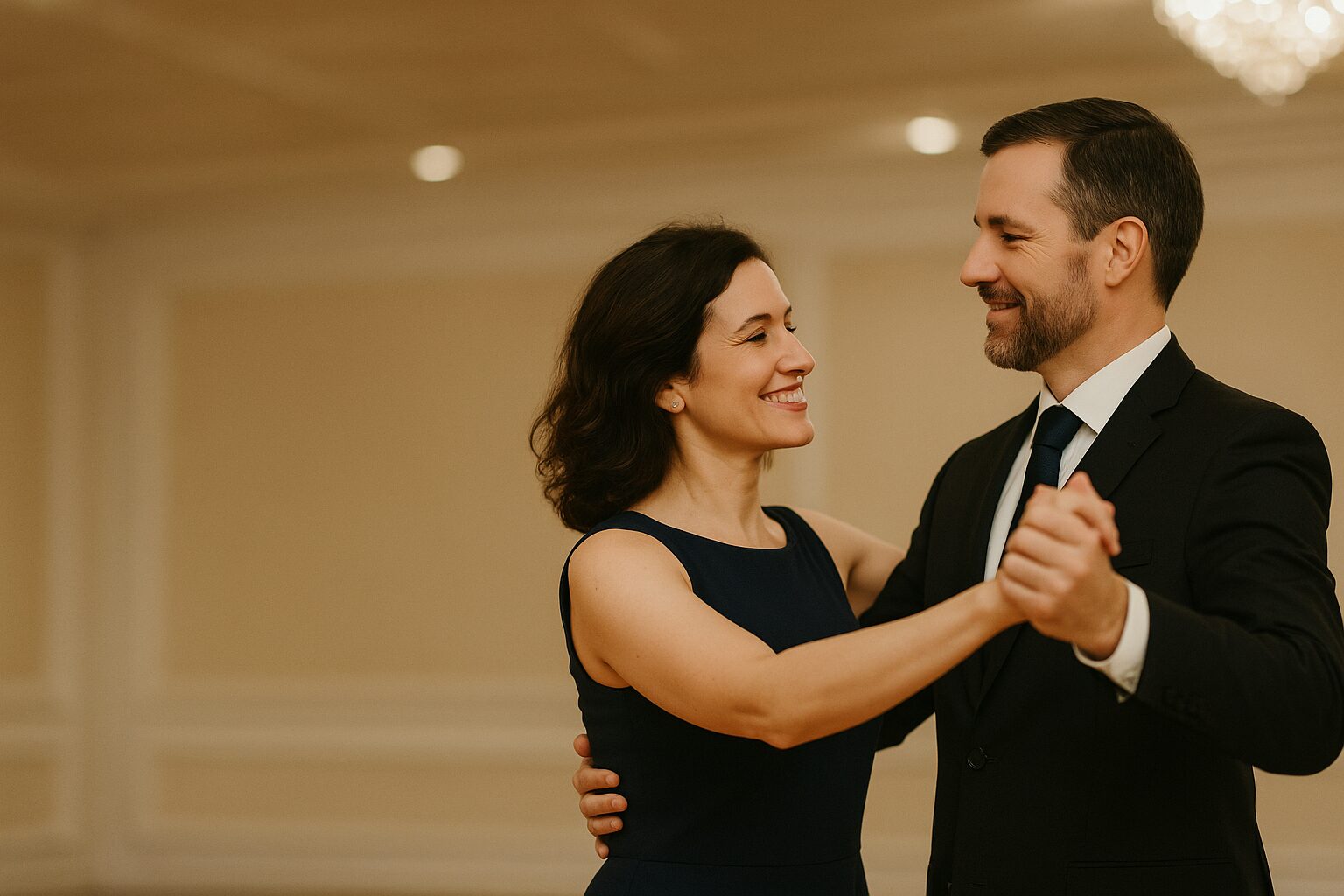
How Ballroom Dancing Trains Your Brain
Ballroom dancing lights up multiple regions of the brain at once, which is one reason dancing makes you smarter over time.
Here’s what’s working behind the scenes every time you step on the floor:
- Motor cortex & cerebellum: Coordinate balance, posture, and precise movement as you turn, rise, and lower.
- Basal ganglia: Help you smoothly switch between steps and rhythms, especially when music changes.
- Hippocampus: Handles learning and remembering choreography, patterns, and sequences—key for memory and processing information.
- Prefrontal cortex: Steps in when you make split-second decisions, improvise, or adjust to your partner, demonstrating intelligence in adapting quickly. Thoughtful, considered responses in dance—where you evaluate options and make mindful choices—are often seen as a sign of creativity and higher-level understanding, in contrast to automatic reactions.
- Mirror neuron networks: Fire when you watch your instructor or partner move, helping you copy and refine steps and better understand new movements.
Instead of training just one area—like you might while doing a crossword—ballroom dance challenges your entire neural network and engages various cognitive processes in the brain, requiring intelligence to evaluate responses and make quick decisions. Dancing helps your brain process and apply information more effectively, and through active engagement, you understand new concepts and skills more deeply. That’s one big reason experts believe dancing supports brain plasticity, cognitive reserve, and sharper thinking well into older adulthood. Additionally, dance has neuroprotective effects and is even used as an intervention for neurological conditions like Parkinson’s disease and Multiple Sclerosis.
Newer research using brain imaging backs this up. One randomized controlled trial found that just three months of structured aerobic dance increased hippocampal volume and improved memory in older adults with mild cognitive impairment, reinforcing dance as a powerful form of “motor-cognitive training” for the aging brain (https://www.frontiersin.org/articles/10.3389/fnagi.2022.771413/full).
Use It Or Lose It: Dancing Makes You Smarter As You Age
As we get older, our brains naturally change. Processing speed may slow down; memory can feel a bit foggier. But “natural” doesn’t mean “inevitable.” Regular ballroom dancing helps build a mental buffer—often called cognitive reserve—that can delay or lessen age-related decline. It also helps reduce stress and leads to increased serotonin level, contributing to overall mental well-being.
For older adults, ballroom dancing offers a rare combination:
- Cardiovascular exercise and cardiovascular benefits to support blood flow to the brain
- Physical exercise that supports both body and mind
- Coordination and better balance work that keeps you steady and confident on your feet
- Continuous learning as you master new patterns, rhythms, and styles
- Rich social interaction that protects against isolation and loneliness
Dancing can increase brain health and neural connectivity, helping to reduce the risk of cognitive decline.
Even better, you don’t need to be a lifelong dancer to benefit. Many Fred Astaire students start in their 50s, 60s, or 70s, and still see improvements in memory, mood, and mental clarity. The key is consistency—showing up, learning, and laughing your way through each lesson.
Which Ballroom Dances Are Best For Brain Health?
Any style that gets you thinking, moving, and connecting will support brain health, but different dances challenge your mind in slightly different ways. Some dances require you to perform precise movements under pressure, while others emphasize creating new moves and variations on the spot. Structured dances involve following a correct sequence of steps, engaging your brain in unique ways.
Here’s a quick snapshot:
| Dance Style | Brain Benefit Highlight | What It Feels Like |
|---|---|---|
| Waltz | Spatial awareness & balance | Gliding, flowing, almost meditative; following a correct sequence of steps |
| Foxtrot | Pattern recognition & timing | Smooth, jazzy, cruising across the floor; requires performing precise movements in the correct order |
| Tango | Focus, emotional expression & sharp directional changes | Intense, dramatic, full of purposeful movement |
| Cha Cha / Rumba | Hip coordination & rhythmic variation | Playful, flirty, rhythm-driven |
| Salsa / Mambo | Fast decision-making & foot speed | High-energy, social, constantly adapting to music and partner; creating new moves and variations |
| Swing | Reaction time & improvisation | Bouncy, joyful, full of spins and creative variations; encourages creating inventive steps in the moment |
Pick one style and you’ll challenge your brain. Learn several, and you’re constantly inviting your nervous system to build new pathways—exactly how “use it or lose it” becomes “use it and improve it.”
How Often Should You Dance To See Brain Benefits?
You don’t need to live in the studio for dancing to make you smarter. But like any brain-healthy habit, regular practice matters.
A simple guideline:
- 1 lesson per week
Great for beginners. You’ll learn fundamentals, feel more coordinated, and start to notice mood and confidence boosts. - 2–3 dance sessions per week
Ideal for brain health and skill growth. This might be a mix of private lessons, group classes, and practice parties. - Short “micro-dances” at home
Even five minutes of reviewing a pattern in your living room helps reinforce memory and motor learning.
At Fred Astaire Dance Studios, many students find a rhythm like: one private lesson + one group class + one social party each week. That’s enough repetition, variety, and fun to keep your brain engaged and your body feeling great.
Why Dancing Beats Other Brain Games
Puzzles, reading, and brain-training apps can all play a role in keeping your mind sharp. But dancing offers something uniquely powerful: it combines thinking, feeling, and moving with real human connection. Research in the field of psychology has shown that dance enhances brain function, thinking styles, and overall cognitive performance.
Historical writings, including dance manuals and other documented works, have long recognized and recorded the mental and physical benefits of dancing.
Compare the classic NEJM findings in simple terms:
| Activity | Approx. Dementia Risk Reduction* | Type Of Challenge |
|---|---|---|
| Reading | Moderate | Cognitive |
| Crossword puzzles (4+ days/week) | Higher | Cognitive & problem-solving |
| Bicycling / swimming / golf | Low to none | Mostly physical |
| Frequent dancing | Highest in the study | Physical, cognitive & social |
*These figures are simplified from the study to illustrate patterns, not to serve as medical advice.
Because dancing makes you smarter on multiple levels at the same time, it stands out as one of the most efficient, joyful ways to invest in long-term brain health.
Designing A Brain-Boosting Dance Routine At Fred Astaire Dance Studios
Ready to turn this science into a real-life routine you’ll actually stick with? Here’s a simple framework you can follow with your local Fred Astaire team.
Step one: Start with a brain-friendly goal
Maybe you want to sharpen your memory, feel more confident socially, or stay mentally sharp as you age. Tell your instructor—your goals help shape your program.
Step two: Mix learning with repetition
A typical week might include:
- One private lesson to break down new patterns and fine-tune technique
- One group class to practice with different partners, follow multiple leads, and build a sense of community
- One practice party to simulate real-world dancing, music changes, and social interaction
This mix is pure gold for neuroplasticity: you learn, repeat, adapt, and then apply skills in a lively, unpredictable environment. Improvisational practice is especially valuable, giving dancers the freedom to explore new movements and encouraging creative thinking.
Step three: Layer in at-home mini-sessions
Put on one song and:
- Walk through a pattern from class
- Practice a basic step in time with the music
- Close your eyes and mentally rehearse a short routine
Even these tiny “mental rehearsals” help strengthen the neural circuits that make dancing second nature—and make thinking faster and clearer in daily life. With regular practice, you’ll feel more comfortable making quick decisions, both on the dance floor and beyond.
Step four: Celebrate your progress
Notice when:
- You remember choreography more easily
- You react faster to music or partner changes
- You feel more mentally awake after a long day
Those small wins are signs that dancing is doing exactly what research says it does—making your brain sharper, more flexible, and more resilient.
Use It Or Lose It: Dancing Makes You Smarter FAQs
What does it really mean when we say dancing makes you smarter?
It means that regular dancing improves cognitive skills like memory, attention, decision-making, and problem-solving, making it easier to learn new concepts and skills. You’re constantly learning patterns, responding to music, and coordinating your body with a partner, which builds stronger and more efficient neural connections over time. These benefits can positively impact many aspects of our lives, from mental agility to emotional well-being.
Is ballroom dancing better for brain health than other types of exercise?
Many forms of exercise help the brain, but growing evidence shows tha ballroom dancing is special because it blends physical movement with complex thinking and social interaction. That triple combination is why studies have found that frequent dancing offers greater protection against dementia than many other common activities.
Do I need to be good at dancing to get the brain benefits?
Not at all. Your brain benefits from the process of learning—trying new steps, making mistakes, adjusting, and improving. Beginners often see big gains because they’re challenging their brains in brand-new ways.
How soon will I notice that dancing makes you smarter or sharper?
Everyone is different, but many students report feeling more mentally alert, focused, and positive within a few weeks of consistent lessons. In fact, research shows that after dancing, participants have performed better on cognitive tasks, with improvements in memory, confidence, and quick decision-making often becoming more noticeable over several months.
Is dancing safe and effective for older adults or people who haven’t exercised in years?
Yes—when guided by trained instructors and, when needed, cleared by a healthcare provider. Fred Astaire Dance Studios customize lessons to each person’s age, fitness, and comfort level. Styles like waltz and foxtrot are especially popular with older adults because they’re low-impact, gentle on the joints, and great for balance and coordination.
Can dancing help if I already have mild cognitive decline?
Dance is not a cure or medical treatment, but it can be a valuable supportive activity. Moving to music, learning new steps, and socializing in a safe, encouraging environment may help maintain function, lift mood, and improve quality of life. Always talk with a healthcare professional for personalized guidance.
How can I get started with a “use it or lose it” dance routine?
The easiest way is to schedule an introductory lesson at your nearest Fred Astaire Dance Studio. You’ll meet an instructor, try a few basic steps, and discuss your goals for brain health, fitness, or fun. From there, you can build a weekly routine that fits your schedule and keeps both your body and your mind happily challenged.
Conclusion: Step Onto The Dance Floor, Strengthen Your Mind
When you look at the research—and at the smiles on the dance floor—it’s clear that dancing makes you smarter in the best possible way. It sharpens memory, boosts mood, builds cognitive reserve, and keeps your brain flexible and responsive at every age. And unlike many “brain workouts,” ballroom dancing is something you’ll actually look forward to.
At Fred Astaire Dance Studios, we believe that every cha-cha, tango, and waltz is more than just a step sequence—it’s a vote for your future brain health. So if you’re ready to “use it” instead of “lose it,” lace up your dance shoes, take that first lesson, and let the music do its magic.
You Might Also Like:
Fred Astaire’s Fountain of Youth: 10 Secrets For Active Aging Through Ballroom Dance – Part One
Fred Astaire’s Fountain of Youth: Active Aging Through Dance- Part 2